Pathogenesis-guided nanozymes: from design to therapy for gastrointestinal inflammation
Authors
Yanjin Du, Zude He, Chong Chen, Fengyu Guo, Fazheng Ren, Pengjie Wang, Yongjian Ai*, Ping Liu*
- aDepartment of Nutrition and Health, China Agricultural University, Beijing, China.
* Correspondence: Address: Yongjian Ai, Department of Nutrition and Health, China Agricultural University, Beijing 100193, China. Email: ayj@ cau.edu.cn (Y. Ai); Ping Liu, Department of Nutrition and Health, China Agricultural University, Beijing 100193, China. Email: ping.liu1@cau.edu.cn (P. Liu).
MedMat · 2026 · Vol. 3 · No. 2 · pp. 147-170
Abstract
Gastrointestinal inflammatory diseases have a significant impact on human health and quality of life, underscoring the urgent need to develop novel treatment strategies. As emerging biomaterials, nanozymes combine the advantages of nanomaterials with enzyme-like catalytic activities, demonstrating considerable potential for managing gastrointestinal inflammation. To provide researchers with a clear and concise overview of recent advances and future directions in this area, this review systematically summarizes and discusses the progress in nanozyme applications for treating gastrointestinal inflammatory disorders, including inflammatory bowel disease, Helicobacter pylori infection, and the like. We begin by elucidating the catalytic mechanisms underlying the major types of nanozymes, including metal-based, metal–organic framework-based, and carbon-based nanozymes. Subsequently, we explore nanozyme designs that enable multifaceted therapeutic effects—including antioxidant, anti-inflammatory, microbiota regulation, and barrier repair functions—through strategies such as multienzyme mimicry, targeted delivery, and stimulus-responsive activation. While challenges related to targeting precision and biosafety remain, nanozymes offer promising opportunities to overcome the limitations of conventional therapies. The review also discusses future prospects, such as artificial intelligence-assisted design, which may accelerate the development of next-generation nanozymes. We believe this work provides a valuable theoretical foundation for the design of efficient and safe nanozyme-based treatments for gastrointestinal inflammation.
Translations
Long abstracts in additional languages. The English article is the version of record.
中文zh-Hans
胃肠道炎症性疾病对人类健康和生命质量产生深远影响,凸显了开发新型治疗策略的紧迫性。作为新兴的生物材料,纳米酶结合了纳米材料的优势与类酶的催化活性,在管理胃肠道炎症方面展现出巨大潜力。本综述旨在为研究人员提供该领域最新进展和未来方向的清晰、简洁概述,系统总结并讨论纳米酶在治疗包括炎症性肠病和幽门螺杆菌感染在内的胃肠道炎症性疾病中的应用进展。
本文首先阐述了主要类型纳米酶的催化机制,涵盖金属基、金属有机框架基以及碳基金属有机骨架基纳米酶。随后,我们探讨了实现多面治疗效果的纳米酶设计策略,这些效果包括抗氧化、抗炎、微生物群调节和屏障修复功能。通过多重酶模拟、靶向递送和刺激响应性激活等策略,纳米酶能够协同发挥多种生物学效应,从而更有效地应对复杂的病理环境。
综述深入分析了不同类别纳米酶的催化机理及其在特定炎症模型中的表现。研究发现,金属基、MOF基及碳基金属有机骨架基材料通过模拟天然过氧化物酶或超氧化物歧化酶等活性,能够有效清除体内过量活性氧自由基,减轻氧化应激反应。同时,靶向递送系统确保了药物在病变部位的富集,而刺激响应性激活机制则实现了治疗活性的时空可控释放,显著提升了治疗的精准度与效率。
尽管纳米酶在治疗胃肠道炎症方面展现出广阔前景,但其在靶向精度和生物安全性方面的挑战仍需克服。现有研究指出,如何进一步提高递送系统的特异性以及长期使用的潜在毒性是未来需要解决的关键问题。此外,综述还探讨了人工智能辅助设计等前沿方向,认为这些技术有望加速下一代高效、安全纳米酶的开发,为胃肠道炎症的精准治疗提供坚实的理论基础和实践指导。
Françaisfr
Les maladies inflammatoires de l'intestin ont un impact significatif sur la santé humaine et la qualité de vie, soulignant la nécessité urgente de développer de nouvelles stratégies thérapeutiques. En tant que biomatériaux émergents, les nanozymes combinent les avantages des nanomatériaux avec une activité catalytique similaire à celle des enzymes, démontrant un potentiel considérable pour la gestion de l'inflammation gastro-intestinale. Cette revue vise à fournir aux chercheurs un aperçu clair et concis des avancées récentes et des orientations futures dans ce domaine, en synthétisant systématiquement les progrès réalisés dans l'application des nanozymes pour traiter les troubles inflammatoires du tractus digestif.
L'article commence par élucider les mécanismes catalytiques sous-jacents aux principaux types de nanozymes, notamment ceux à base métallique, à base de réseaux organométalliques et à base de carbone. Par la suite, nous explorons des conceptions de nanozymes permettant des effets thérapeutiques multifactoriels — incluant les fonctions antioxydantes, anti-inflammatoires, de régulation du microbiote et de réparation de la barrière intestinale — grâce à des stratégies telles que le mimétisme multi-enzymatique, l'administration ciblée et l'activation par stimulus.
La revue analyse en détail comment ces matériaux catalytiques agissent pour neutraliser les espèces réactives de l'oxygène excédentaires dans divers modèles d'inflammation. Les résultats montrent que la combinaison de propriétés enzymatiques multiples au sein des nanozymes permet une réponse thérapeutique synergique, surpassant souvent les thérapies conventionnelles qui ne ciblent qu'un seul aspect pathologique. L'utilisation de systèmes de délivrance intelligents assure un relargage contrôlé du traitement uniquement en présence de signaux inflammatoires spécifiques, optimisant ainsi l'efficacité tout en minimisant les effets systémiques indésirables.
Bien que prometteuses pour surmonter les limites des thérapies conventionnelles, les nanozymes présentent encore des défis liés à la précision du ciblage et à la biosécurité qui doivent être résolus. La revue discute également de perspectives futures telles que la conception assistée par intelligence artificielle, susceptible d'accélérer le développement de nanozymes de nouvelle génération. Nous estimons que ce travail fournit une base théorique précieuse pour concevoir des traitements basés sur les nanozymes efficaces et sûrs contre l'inflammation gastro-intestinale, tout en identifiant clairement les obstacles restants à franchir pour leur translation clinique.
Españoles
Las enfermedades inflamatorias gastrointestinales tienen un impacto significativo en la salud humana y la calidad de vida, subrayando la necesidad urgente de desarrollar nuevas estrategias terapéuticas. Como biomateriales emergentes, las nanoenzimas combinan las ventajas de los nanomateriales con actividades catalíticas similares a enzimas, demostrando un potencial considerable para gestionar la inflamación gastrointestinal. Esta revisión tiene como objetivo proporcionar a los investigadores una visión clara y concisa de los avances recientes y direcciones futuras en este ámbito, resumiendo sistemáticamente y discutiendo el progreso en las aplicaciones de nanoenzimas para tratar trastornos inflamatorios gastrointestinales, incluyendo enfermedad intestinal inflamatoria e infección por Helicobacter pylori.
Comenzamos elucidando los mecanismos catalíticos subyacentes a los principales tipos de nanoenzimas, incluidas aquellas basadas en metales, marcos metal-orgánicos y carbono. Posteriormente, exploramos diseños de nanoenzimas que permiten efectos terapéuticos multifacéticos —incluyendo funciones antioxidantes, antiinflamatorias, regulación de la microbiota y reparación de barrera— mediante estrategias como el mimetismo multi-enzimático, administración dirigida y activación sensible a estímulos. Estos enfoques buscan optimizar la interacción entre los materiales sintéticos y el entorno biológico complejo del tracto digestivo.
La revisión analiza en profundidad cómo estos materiales catalíticos actúan para neutralizar especies reactivas de oxígeno excesivas en diversos modelos inflamatorios, demostrando que las nanoenzimas pueden superar limitaciones de terapias convencionales. Se destaca que la combinación de propiedades enzimáticas múltiples dentro de las nanoenzimas permite una respuesta terapéutica sinérgica, mientras que los sistemas de administración inteligentes aseguran un liberación controlada del tratamiento solo ante señales inflamatorias específicas, optimizando así la eficacia y minimizando efectos sistémicos no deseados.
Aunque prometedoras para superar las limitaciones de terapias convencionales, las nanoenzimas aún presentan desafíos relacionados con la precisión del direccionamiento y la biosseguridad que deben resolverse. La revisión también discute perspectivas futuras como el diseño asistido por inteligencia artificial, lo cual podría acelerar el desarrollo de nanoenzimas de próxima generación. Creemos que este trabajo proporciona una base teórica valiosa para diseñar tratamientos basados en nanoenzimas eficientes y seguros contra la inflamación gastrointestinal, identificando claramente los obstáculos restantes para su traducción clínica.
日本語ja
消化管炎症性疾患は人間の健康と生活の質に大きな影響を与えており、新たな治療戦略の開発が緊急に求められています。新興生物材料であるナノザイムは、ナノ材料の利点と酵素様触媒活性を組み合わせることで、消化管炎症の管理において相当な可能性を示しています。本レビューでは、研究者に対してこの分野における最新の進展と将来の方向性に関する明確かつ簡潔な概要を提供し、炎症性腸疾患やピロリ菌感染などを含む消化管炎症性障害の治療に対するナノザイム応用の進歩を体系的に要約・検討します。
まず、金属基、金属有機骨格(MOF)基、および炭素基の主要なナノザイムの背後にある触媒メカニズムについて解明し、その基本原理を説明します。その後、抗酸化作用、抗炎症作用、微生物叢調節、バリア修復機能といった多面的な治療効果を可能にするナノザイム設計を探求します。これらは、マルチ酵素模倣、標的指向性送達、刺激応答型活性化などの戦略を通じて実現され、複雑な病理環境においてより効果的な治療を可能にします。
レビューでは、異なるカテゴリーのナノザイムの触媒メカニズムと特定の炎症モデルにおけるその挙動について詳細に分析しています。金属基、MOF基、および炭素骨格材料は、天然酵素である過酸化水素分解酵素やスーパーオキシドディスムターゼなどを模倣することで、体内の過剰な活性酸素種を効果的に除去し、酸化ストレス反応を軽減することが示されています。さらに、標的送達システムにより薬剤が病変部位に集積され、刺激応答型活性化メカニズムによって治療活性の時間・空間的な制御放出が可能となり、治療の精度と効率が大幅に向上します。
ナノザイムは従来の療法における限界を克服する有望な機会を提供しますが、標的指向性の精度や生物学的安全性に関する課題はまだ残っています。レビューでは、人工知能支援設計などの将来の可能性についても言及しており、これらの技術が次世代のナノザイムの開発を加速し、より効率的で安全な治療法の創出に寄与すると期待されています。本稿は、消化管炎症に対する効果的で安全なナノザイムベースの治療法を設計するための貴重な理論的基盤を提供するものであり、臨床応用に向けた残された課題と解決策の方向性を明確に示しています。
العربيةar
تؤثر الأمراض الالتهابية المعوية بشكل كبير على صحة الإنسان وجودة حياته، مما يبرز الحاجة الملحة لتطوير استراتيجيات علاجية جديدة. كمواد حيوية ناشئة، تجمع الإنزيمات النانوية بين مزايا المواد النانوية والأنشطة التحفيزية المشابهة للإنزيمات، وتظهر إمكانات كبيرة في إدارة الالتهاب المعوي. تهدف هذه المراجعة إلى تزويد الباحثين بنظرة واضحة وموجزة للتطورات الحديثة والاتجاهات المستقبلية في هذا المجال، من خلال تلخيص ونقاش التقدم المحرز في تطبيقات الإنزيمات النانوية لعلاج الاضطرابات الالتهابية الهضمية، بما في ذلك أمراض الأمعاء الالتهابية وعدوى المطثية العسيرة وغيرها.
نبدأ بتوضيح الآليات التحفيزية الكامنة وراء الأنواع الرئيسية من الإنزيمات النانوية، بما في تلك القائمة على المعادن، والأطر المعدنية العضوية، والمواد الكربونية. بعد ذلك، نستكشف تصاميم للإنزيمات النانوية تمكن من تحقيق تأثيرات علاجية متعددة الأوجه —بما في ذلك الوظائف المضادة للأكسدة ومضادات الالتهاب وتنظيم الميكروبيوتا وإصلاح الحاجز— من خلال استراتيجيات مثل محاكاة الإنزيمات المتعددة، والتوصيل المستهدف، والتنشيط الحساس للمحفزات. تهدف هذه الاستراتيجيات إلى تحسين التفاعل بين المواد الاصطناعية والبيئة البيولوجية المعقدة في الجهاز الهضمي.
تقوم المراجعة بتحليل بعمق كيف تعمل هذه المواد التحفيزية على تحييز الأنواع الأكسجينية الزائدة في نماذج التهاب مختلفة، مما يظهر أن الإنزيمات النانوية يمكنها التغلب على قيود العلاجات التقليدية. يُبرز العمل أن الجمع بين خصائص إنزيمية متعددة داخل الإنزيمات النانوية يسمح باستجابة علاجية تآزرية، بينما تضمن أنظمة التوصيل الذكية إطلاقًا محكومًا للعلاج فقط عند وجود إشارات التهابية محددة، مما يحسن الفعالية ويقلل من الآثار الجانبية الجهازية غير المرغوب فيها.
على الرغم من كونها واعدة للتغلب على قيود العلاجات التقليدية، لا تزال الإنزيمات النانوية تواجه تحديات تتعلق بدقة الاستهداف والسلامة البيولوجية التي يجب حلها. تناقش المراجعة أيضًا آفاقًا مستقبلية مثل التصميم بمساعدة الذكاء الاصطناعي، والذي قد يسرع تطوير الجيل القادم من الإنزيمات النانوية. نعتقد أن هذا العمل يوفر أساسًا نظريًا قيمًا لتصميم علاجات فعالة وآمنة قائمة على الإنزيمات النانوية ضد الالتهاب المعوي، مع تحديد بوضوح العقبات المتبقية أمام ترجمتها السريرية.
Keywords
Full Text
1. Introduction
Nanozymes are a class of nanomaterials with enzymatic catalytic activity. Their unique physicochemical properties have opened up broad application prospects in the biomedical field. Since the discovery of nanozymes by the research team led by Yan Xiyun in 2007, their study has rapidly become a hot topic across interdisciplinary fields[1,2]. Nanozymes not only exhibit the size effects, surface effects, and quantum effects characteristic of nanomaterials but also possess catalytic activity similar to that of natural enzymes, enabling them to efficiently catalyze substrate reactions. Compared with natural enzymes, nanozymes offer advantages such as high stability, low cost, and scalability for large-scale production, making them potentially valuable in disease diagnosis, treatment, and biosensing applications[3]. As functional nanomaterials with intrinsic enzymatic activity, modern nanozymes have transcended the simple concept of “natural enzyme mimicry” and evolved into intelligent systems capable of precisely regulating catalytic performance[4]. Through advanced characterization techniques and theoretical calculations, the structural basis of nanozymes activity has been elucidated. The catalytic activity of metal oxide nanozymes (eg, Mn3O4) stems from changes in metal valence states (Mn2+/Mn3+/Mn4+) and oxygen vacancy regulation. The active centers of carbon-based nanozymes are composed of defect sites (5-membered rings/7-membered rings) and heteroatoms (N, S). Metal-organic framework (MOF) nanozymes mimic enzyme active pockets through metal-ligand coordination environments. Given that the catalytic performance and behavior of nanomaterials are closely related to their intrinsic nanostructures, regulating size, shape, composition, and surface properties continuously enhances the catalytic efficiency of nanozymes. Thanks to their unique properties, nanozymes have rapidly gained prominence in the field of disease treatment in recent years[4]. A growing body of research has been published, establishing them as a hotspot in areas such as tumor therapy, antioxidant applications, antibacterial agents, and anti-inflammatory treatments.
The gastrointestinal tract, as the core site for digestion and absorption in the human body, exhibits a highly specialized multilayered barrier system in its structure. Its wall consists of the mucosa, submucosa, muscularis, and serosa/epimucosa from inner to outer layers. As the core functional unit, the mucosa differentiates specialized cells in the stomach-parietal cells secreting hydrochloric acid and goblet cells forming the mucus-bicarbonate barrier. In the intestine, the "circular folds-villi-microvilli" tripartite structure maximizes the absorption surface area. Tight junctions (TJs) between intestinal epithelial cells form a physical barrier, while goblet cells secrete mucus to create a chemical barrier. Paneth cells release antimicrobial peptides, and the dense immune cells within the lamina propria collectively establish an immune barrier[5,6]. Gastrointestinal inflammatory (GI) diseases, including inflammatory bowel disease (IBD), Helicobacter pylori (H pylori)-associated gastritis, and so on, are common conditions that significantly impact human health. IBD (including ulcerative colitis [UC] and Crohn’s disease [CD]) is characterized by damage to the intestinal mucosal barrier, oxidative stress, and chronic inflammatory responses[7]. H pylori infection is a major risk factor for chronic gastritis, peptic ulcers, and even gastric cancer[8]. Current clinical treatment faces unique challenges due to the dynamic pH gradient of the digestive tract (1.5–3.5 in the stomach, 6–8 in the intestines), the thick mucus barrier (50–300 μm), and the complex microbiota (10¹3–10¹4 colony-forming unit [CFU]), which together form multiple physiological barriers. IBD is characterized by a vicious cycle of oxidative stress (reactive oxygen species [ROS] far exceeding physiological levels) and chronic inflammation (elevated proinflammatory factors)[9], while H pylori infection involves challenges such as biofilm formation and antibiotic resistance[10]. Traditional drugs (5-aminosalicylic acid, proton pump inhibitors, etc) have limitations such as poor lesion accumulation and microbial community disruption[11]. Nanozymes, with their unique catalytic properties, offer new insights into the treatment of GI. On the one hand, nanozymes can efficiently clear ROS through multienzyme synergistic action, thereby alleviating oxidative stress damage. On the other hand, through surface functionalization modification, nanozymes can achieve targeted delivery to the site of inflammation and microenvironment-responsive activation. At the material design level, gastrointestinal environmental stability is enhanced through metal doping (eg, Cu/Zn/I codoping) and surface engineering (eg, polydopamine coating). In terms of mechanism of action, nanozymes integrate multiple functions, including antioxidant (scavenging O2•⁻/H2O2), anti-inflammatory (inhibiting NLRP3 inflammasome), and barrier repair (upregulating claudin-1). In terms of delivery strategies, oral colon-targeted (pH/enzyme dual-responsive) and mucosal adhesion (chitosan-modified) systems have been developed.
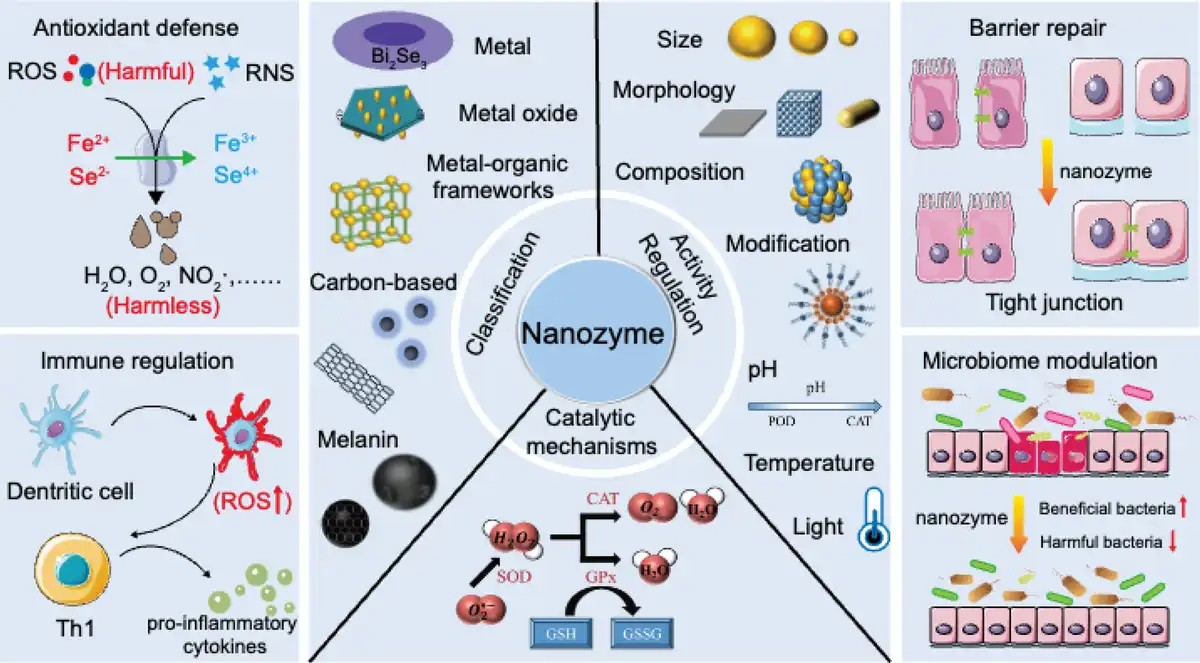
In recent years, notable progress has been made in the application of nanozymes for the treatment of gastrointestinal disorders. Despite these advancements, the field still lacks a comprehensive and systematic review that consolidates the latest research achievements. A thorough critical analysis of current developments would be highly instrumental, as it could not only guide future research efforts in IBD but also accelerate the evolution of nanozymology as a discipline. Herein, this review represents the first comprehensive review of the application progress of nanozymes in this field over the past 5 years (2019–2025), establishing a complete knowledge framework. We conducted comprehensive searches through electronic databases such as Web of Science and PubMed, using keywords including “nanozyme,” “inflammatory bowel disease,” “colitis,” “gastritis,” “gastrointestinal inflammation,” and their combinations. Inclusion criteria focused on original research articles published between January 2019 and August 2024 that explicitly explored the therapeutic application of nanozymes in experimental models of gastrointestinal inflammation. Conference abstracts and studies not primarily centered on therapeutic efficacy were excluded. The review content adopts a progressive structure, first establishing the theoretical foundation and systematically elucidating the catalytic mechanisms and activity regulation of nanozymes. It then delves into the innovative applications of various types of nanocatalysts in GI treatment, using typical cases to reveal their multifaceted mechanisms of action, including antioxidant, anti-inflammatory, and barrier repair effects (Scheme 1). Finally, objectively assesses the current challenges (such as targeting and long-term safety) and prospectively proposes future development directions (such as artificial intelligence [AI]-assisted design). This study provides a relatively comprehensive summary of the application of nanozymes in GI over the past 5 years, providing important theoretical support and practical guidance for the development of a new generation of GI treatment strategies.
Scheme 1.
The classification, catalytic mechanism, activity regulation, and therapeutic mechanism of nanozymes in gastrointestinal inflammation. Some elements created with Bioicons.com.
2. Pathogenesis-guided nanozymes
Traditional nanozyme research paradigms have primarily focused on material-driven approaches (eg, exploring the intrinsic enzymatic activity of metal-based nanomaterials such as Fe, Ce, and Mn) and function-driven approaches (eg, optimizing peroxidase activity to enhance chemotherapeutic efficacy). However, for complex diseases such as gastrointestinal inflammation, this “single-activity-single-target” strategy often struggles to address their multifactorial, interrelated pathological characteristics. In contrast, pathogenesis-driven design represents a paradigm shift. Its core concept involves a top-down approach: starting from the disease’s core pathogenesis, reverse-engineering nanozymes to possess multifunctionality capable of simultaneously intervening in multiple critical pathological pathways. This strategy ensures precision and efficiency in therapeutic intervention. This section outlines corresponding nanozyme design principles centered on the 4 core mechanisms of GI.
2.1 Detoxification design targeting ROS overload
ROS are highly reactive molecular substances produced by aerobic organisms during normal physiological activities. They generally refer to oxygen-containing free radicals and nonfree radical derivatives with strong redox properties, including O2•, H2O2, •OH, etc[12]. GI is often accompanied by excessive ROS production. Excessive ROS can disrupt the stability of the body’s antioxidant defense system, leading to oxidative stress and damage to cellular structures, including oxidative damage to DNA, lipids, proteins, and biological membranes[2]. The design principle for this mechanism is to endow nanozymes with broad-spectrum, highly efficient antioxidant enzyme mimetic activity. For instance, CeO2 or MnO2-based nanozymes mimic the cascading activities of superoxide dismutase (SOD) and catalase (CAT), converting superoxide anion (O2•⁻) and hydrogen peroxide (H2O2) into harmless water instead of generating more toxic •OH radicals (as some peroxidases do), thereby achieving true “detoxification” rather than “toxification.”
2.2 Immunoregulatory design targeting immune cells
Design nanozymes capable of intelligently regulating the fate of immune cells. For example, surface-functionalize them to target macrophages and utilize their catalytic activity to reprogram proinflammatory M1 macrophages into anti-inflammatory M2 macrophages[13,14], or suppress excessive NLRP3 inflammasome activation by scavenging ROS[15]. A more advanced design involves developing catalytic nanozymes that directly target and degrade NLRP3 messenger RNA or inflammasome components, enabling more precise immune regulation.
2.3 Repair design for intestinal barrier damage
Loss of intestinal barrier integrity is the root cause of pathogen invasion and persistent inflammation. The design principle here is to enhance nanozyme interactions with epithelial cells to protect and repair TJs[16]. This can be achieved through surface functionalization of nanozymes (eg, by attaching peptides targeting epithelial cells), enabling their enrichment at damaged sites. Subsequently, their antioxidant activity mitigates oxidative damage to TJ proteins (eg, Zonula Occludens-1 [ZO-1], Occludin) and may promote epithelial cell proliferation and migration by modulating relevant cellular signaling pathways.
2.4 Microenvironment regulation design for gut microbiota dysbiosis
Dysbiosis and inflammation mutually reinforce each other. Nanozyme design must focus on restoring a healthy intestinal microenvironment[17]. On one hand, reducing oxidative stress levels in the intestinal lumen creates a suitable growth environment for beneficial bacteria (eg, Lactobacillus, Bifidobacterium)[18,19]. On the other hand, nanozymes with lysozyme-like activity can be engineered to selectively disrupt the cell walls of opportunistic pathogens, thereby directly regulating microbial composition and abundance.
In summary, pathogenesis-driven design elevates nanozymes from mere catalytic materials to “smart drugs” capable of actively deciphering and intervening in disease networks. This approach transcends traditional strategies focused on maximizing single activities, instead pursuing the optimization of multiple synergistic therapeutic effects within complex pathological environments. This represents the future direction of nanozyme applications in biomedicine.
3. Catalytic activity of nanozymes
Based on the blueprint of pathological mechanisms, clear requirements have been established for the catalytic properties of nanozymes themselves. How, then, do nanozymes achieve complex catalytic functions at the atomic and molecular levels? And through which strategies can their activity be precisely regulated? This section will focus on the core fundamentals of nanozyme catalytic mechanisms and activity regulation, systematically elucidating how they enable the possibility of precise pathological intervention.
3.1 Catalytic mechanisms of nanozymes
3.1.1 SOD-like nanozyme
SOD is the primary cellular defence against superoxide radicals () and protects organisms from oxidative stress[20]. is the key element in the production of ROS that are produced as a byproduct of metabolic processes in living systems. In the presence of SOD, generated during metabolism disproportionately are converted to hydrogen peroxide and oxygen (Equation 1)[21].
Most SOD nanozymes consist of transition metals (Cu, Fe, Ce, etc) and elements such as N, O, C, and S. The mechanism of action of SOD relies on the cycling of the reduced and oxidized states of redox-active transition metals (eg, Cu and Mn) at their active sites (Equations 2 and 3)[22,23]. In general, consists of Brønsted bases with pKb = 9.12[24], and thus can trap protons from H2O to form HO2− and HO−. HO2− adsorption on the surfaces of gold, silver, palladium, and platinum triggers the conversion of HO2− to O2 and H2O2[20].
For example, CeO2 nanozymes are well known SOD mimics[25]. Changes in the oxidation state of CeO2 produce oxygen vacancies in the lattice structure through the release of oxygen and electrons. Oxygen vacancies play a key role in displaying SOD-like activity, enabling CeO2 nanozymes to take up or release oxygen. The presence of Ce3+ is a consequence of oxygen vacancies; thus, a high Ce3+/Ce4+ ratio provides more oxygen vacancies, which enhances SOD-like activity. The decomposition of by CeO2 nanozymes is shown in Figure 1 (SOD-part CeO2).
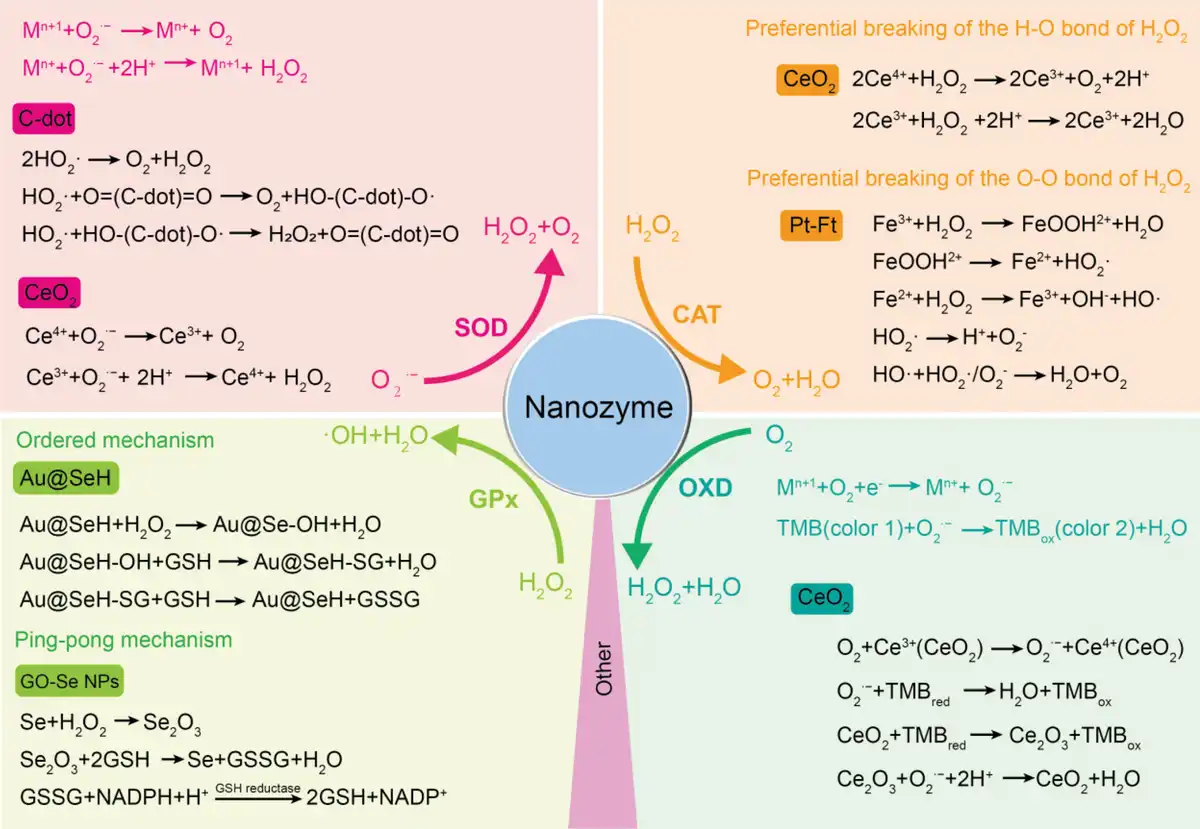
Figure 1.
Catalytic mechanism and example formula of nanozymes.
C-dot nanozymes are also typical enzymes with SOD-like activities. Gao et al.[26] revealed the surface state-dependent catalytic activity of C-dot SOD nanozymes by surface structural tuning and theoretical calculations. The hydroxyl and carboxyl groups of the C-dots bind superoxide anions, and the carbonyl groups oxidize superoxide anions, producing oxygen and reduced-state C-dots. The reduced C-dots are oxidized back into the initial state by another superoxide anion and produce H2O2. The carbonyl group of C-dot nanozymes is the catalytic site for SOD-like activity, and its proposed reaction pathway for the SOD-like catalytic cycle with and without hydroxyl group is shown in Figure 2A. The reasonable mechanism of SOD-like activity with C-dots as catalytic sites is shown in Figure 1 (SOD-part C-dots).
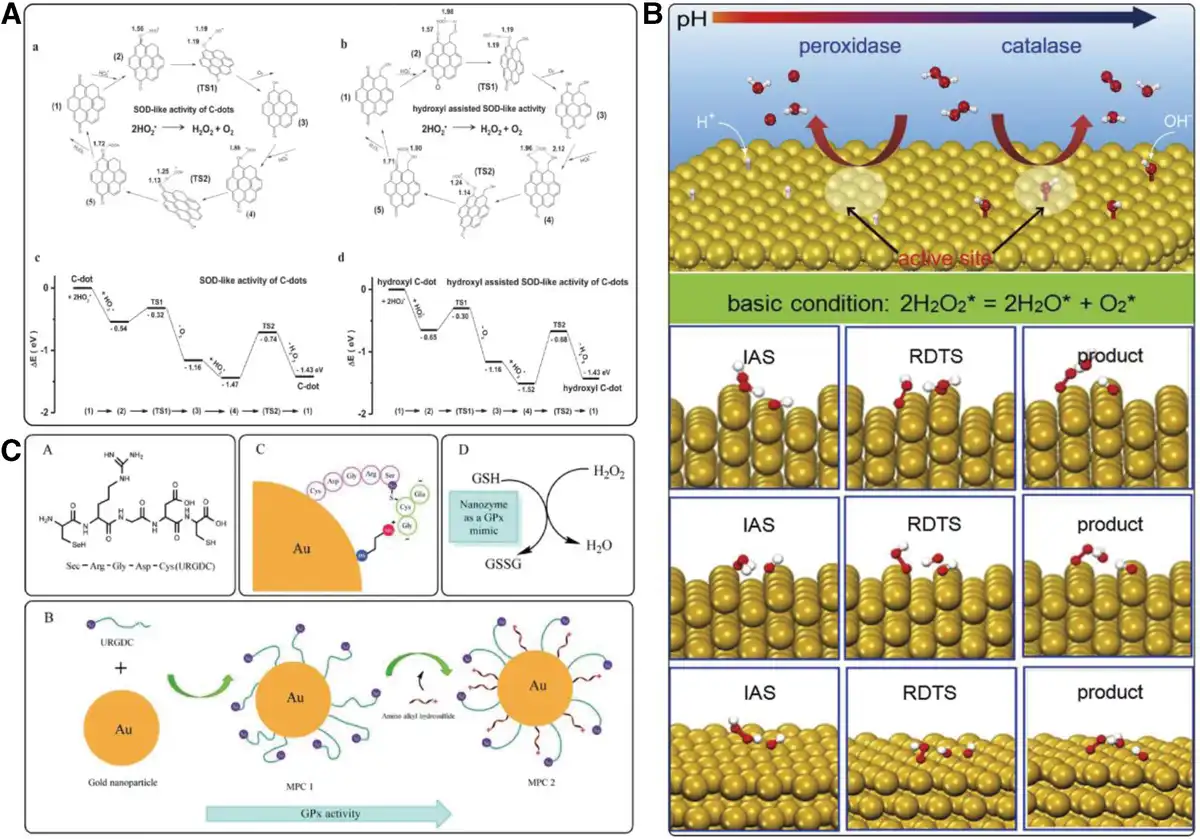
Figure 2.
(A) Proposed SOD-like activity of C-dot nanozyme with and without hydroxyl groups[26]. Copyright 2023, Nature Communications. (B) Initial adsorbing structures (IAS), rate-determining transition states (RDTS) and products for H2O2 decompositions on the surfaces of Au (211) (top), Au (110) (middle), and Au (111) (bottom)[33]. Copyright 2015, Elsevier. (C) Structural formula, active site, and mechanism of catalytic reduction of H2O2 by GSH of a GPx-active nanozyme[40]. Copyright 2024, The Royal Society of Chemistry.
3.1.2 CAT-like nanozyme
CAT is an antioxidant enzyme containing iron porphyrin in its active site and is present in almost all organisms that come into contact with oxygen[27]. CAT catalyzes the degradation of 2 hydrogen peroxide molecules to produce 2 water molecules and 1 oxygen molecule (Equation 4), thereby protecting tissues from potential oxidative damage. First, the iron porphyrin group of CAT (Fe3+) reacts with 1 hydrogen peroxide to form an iron porphyrin cation radical (Fe4+). The radical then degrades the hydrogen peroxide to produce water and oxygen molecules, while the Fe4+ is reduced to the Fe3+ state[28]. When iron chelates are in action, H2O2 reacts with O2 to form the harmful -OH, which occurs only when 2 H2O2 molecules encounter the CAT successively and hit its active site[2].
To date, a series of metal-related nanozymes, such as platinum (Pt), gold (Au), CeO2, and Mn3O4, have been shown to possess CAT-like activities[29]. Although the full mechanism of CAT-like nanozymes has not been fully elucidated, 2 possible catalytic reaction pathways have been summarized based on the pattern of chemical bond breaking during H2O2 decomposition[30].
The first catalytic reaction pathway is the preferential breaking of the H-O bond of H2O2. Pirmohamed et al.[31] found that CeO2 nanozyme exhibits CAT-like activity through redox reactions, and higher levels of Ce4+ would contribute to the catalytic activity. Subsequently, Celardo et al.[32] further elucidated the antioxidant mechanism of CeO2 nanozymes (Figure 1 CAT-part CeO2). First, H2O2 was adsorbed on the CeO2 surface, followed by the release of 2 protons and the production of O2, while Ce4+ was reduced to Ce3+. Then, another H2O2 molecule binds to Ce3+ and produces H2O, at which time Ce3+ is oxidized to Ce4+. In addition, Li et al.[33] investigated the enzyme-like activities on the surfaces of Au (211), Au (110), and Au (111) under acidic and alkaline conditions by analyzing experimental data and density functional theory (DFT). Comparison of reaction energy barriers and adsorption energies showed that preadsorbed OH groups have a strong influence on H decomposition and catalyze the preferential breaking of H-O bonds by H2O2 (Figure 2B). A similar situation is observed for other metals (eg, Ag, Pt, and Pd).
The second catalytic reaction pathway is the preferential breaking of the O-O bond of H2O2. The CAT-like activity of metal oxide nanoparticles (NPs) is usually derived from ionic pairing, such as Fe2+/Fe3+, Co2+/Co3+, Mn3+/Mn4+, and Ni2+/Ni3+[2]. The discovery of ferromagnetic nanoparticles with peroxidase-like activity was reported in 2007, and these are believed to be the first inorganic nanoparticles to be used as enzyme mimics for biomedical applications[1]. Subsequently, in 2011, Nie’s group observed that ferritin-platinum nanoparticles (Pt-Ft) have CAT-like activity under alkaline and neutral pH conditions, and the decomposition process can be summarized in Figure 1 (CAT-part Pt-Ft)[34]. In addition, Wang et al.[35] prepared Pd@TiO2 with lattice defects and cavities, and similarly demonstrated that H2O2 adsorbed on the surface of Pd@TiO2 is more prone to break the O-O bond, and thus cleaved into 2 -OHs, which undergo a transition state to ultimately produce.
3.1.3 Glutathione peroxidase-like nanozyme
The peroxidase (POD) family is very large and most of the peroxidases are heme enzymes with iron protoporphyrin IX (protoheme) as a repair moiety, such as horseradish peroxidase, lignin peroxidase, and myeloperoxidase[29]. Currently, much attention is being paid to peroxidases with selenium as the active center (glutathione peroxidase, GPx), which are involved in the termination of the ROS pathway, thereby reducing oxidative stress[36]. The active site of GPx contains selenocysteine, where selenohydrin (ESeH) degrades H2O2 to H2O by redox and is oxidized to form selenoic acid (ESeOH). ESeOH then undergoes a redox reaction with 2 reduced glutathione (GSH) and reverts to ESeH. In this redox cycle, the 2 GSH are oxidized to form 2 glutathione disulfides (GSSG)[37]. GPx has been found to catalyze multisubstrate reactions through an ordered mechanism[38] and a ping-pong mechanism[39].
The ordered mechanism suggests that GPx binds to multiple substrates in a specific order and then releases the product when all substrates bind to GPx. Zhang et al.[40] prepared selenium-containing pentapeptide-modified Au NPs (Au@SeH), and kinetic analyses showed that Au@SeH adsorbed an H2O2 molecule first, and then bound to 2 GSH molecules sequentially (Figure 1 GPx-part Au@SeH). In this process, Au@SeH catalyzed the reduction of H2O2 to H2O by GSH (Figure 2C).
The ping-pong mechanism suggests that GPx binds or releases alternately with substrates and products. Huang et al.[41] synthesized GO-Se NPs with more efficient GPx-like activity. Se reacts with H2O2 to form Se2O3 intermediates. The resulting intermediate catalyzes the conversion of GSH to GSSG, while the Se intermediate returns to its original state. The GSH reductase can then catalyze the conversion of GSSG to GSH with the aid of nicotinamide adenine dinucleotide phosphate. Then, Se will react with another molecule of H2O2 (Figure 1, GPx-part GO-Se NPs). Thus, the catalytic mechanism of GO-Se NPs follows the ping-pong mechanism of catalytic degradation of H2O2.
3.1.4 Oxidase-like nanozyme
Oxidase (OXD) is a class of enzymes that directly utilize O2 as an electron acceptor to catalyze the oxidation of substrates[42]. Certain nanomaterials (such as MnO2, CeO2, and CuO) can mimic the activity of natural oxidases, oxidizing specific substrates (such as TMB and DOPA) without the presence of H2O2, accompanied by colorimetric reactions or the generation of ROS. Their catalytic mechanism primarily involves 3 key steps. First, the surface of the nanomaterials adsorbs and activates O2 through changes in the valence state of metal ions (e.g., Mn4+/Mn3+ or Cu2+/Cu+), generating ROS. Subsequently, these ROS attack substrate molecules (e.g., oxidizing colorless TMB to blue oxTMB), completing the colorimetric or fluorescent reaction. Finally, metal ions on the surface of the nanomaterials (e.g., Cu2+ and Mn4+) are continuously reduced and oxidized during the reaction, maintaining the catalytic cycle.
For example, Cheng et al.[43] investigated the O2-dependent catalytic behavior of CeO2 and confirmed its OXD-type activity under the study conditions. In the reaction mechanism, O2 molecules were adsorbed onto defect sites of nanoceria and converted to under acidic conditions. As surface Ce4+ is reduced to Ce3+, TMB is oxidized to TMBX. As the primary intermediate, the in situ-generated ultimately regenerates Ce4+ by oxidizing Ce3+ while producing water. Additionally, the oxidation of TMB can also be directly initiated by (Figure 1 OXD-part CeO2). The possible reaction mechanism of Mn3O4 nanoparticles proposed by Zhang and Huang[44]. The transfer of manganese to O2 electrons leads to the formation of , part of which undergoes a nonenzymatic or SOD-catalyzed disproportionation reaction to produce H2O2 and O2. Subsequently, part of the generated H2O2 reacts with dissolved Mn2+ and decomposes into ·OH. Subsequently, the intermediate ·OH/ and Mn3+ oxidize TMB, thereby forming the TMB–Mn3O4 nanoparticle system.
Other nanozymes similar to oxidases catalyze specific substrates. For example, Au nanozymes catalyze glucose similarly to glucose oxidase[45], CuAg alloys[46], and Cu2O[47] catalyze similarly to cytochrome c oxidase. Pt NPs catalyze similarly to catechol oxidase[48]. Au nanorods/Pt nanodots and PtCu NPs catalyze similarly to iron oxidase[49].
3.1.5 Other-like nanozyme
In addition to the oxidoreductase family, other biologically active nanocatalysts have been increasingly discovered, including hydrolase-like, isomerase-like, and lyase-like enzymes. For example, peptide-functionalized monolayer-protected gold clusters (Au MPCs) have been shown to exhibit simulated activity of nucleases, esterases, and silicases[50]. Cerium nanoparticles (CeNPs) have also been found to exhibit phosphatase-like properties, capable of hydrolyzing the phosphate bonds of ATP, p-nitrophenyl phosphate, and o-phosphotyrosine[51]. Magnetic CuFe2O4 exhibits intrinsic protease-like activity, capable of hydrolyzing bovine serum albumin and casein under physiological conditions[52]. CdTe quantum dots (4.5 nm) can recognize GAT^ATC DNA sequences and induce light-triggered T^A phosphodiester bond cleavage[53]. Cysteine-derived chiral carbon dots exhibit activity similar to topoisomerase I, mediating enantioselective topological rearrangement of supercoiled DNA[54]. Additionally, some nanomaterials can catalyze biochemical reactions that natural enzymes cannot, such as MOF-Cu-catalyzed azide-alkyne cycloaddition[55] and Pd nanoparticles-catalyzed hydrogenation of ·OH[56].
3.1.6 Catalytic mechanisms and their function in gastrointestinal inflammation therapy
Nanozymes mimic the catalytic activities of multiple natural enzymes to establish a multitarget synergistic therapeutic system for GI. In ROS scavenging, different enzymatic activities coordinate to form cascading reactions. SOD-CAT cascade system achieves complete detoxification from superoxide anion to water, effectively breaking the vicious cycle of oxidative stress-inflammation. These antioxidant mechanisms suppress proinflammatory factor release by eliminating ROS signals required for NLRP3 inflammasome activation. They also promote macrophage polarization from M1 to M2 by regulating intracellular H2O2 levels, thereby restoring immune homeostasis. For mucosal repair, besides protecting TJ proteins through antioxidant effects, the OXD mimic enzyme actively promotes epithelial regeneration by modulating H2O2-mediated Nrf2 signaling pathways. GPx preserves cell membrane integrity by reducing lipid peroxides[36]. For gut microbiota regulation, nanozymes restore microbial balance through multiple pathways: enhancing beneficial bacterial proliferation by improving the redox microenvironment, while achieving selective antibacterial effects via •OH radicals generated by POD activity or lysozyme-like activity. This synergistic mechanism-function-therapy framework positions nanozymes as an ideal therapeutic strategy for GI.
3.2 Activity regulation strategy
Given that the catalytic performance and behavior of nanozyme are closely related to their intrinsic nanostructure, regulating size, shape, composition, and surface properties may open new avenues for modifying their activity. Therefore, this section summarizes chemical design strategies and corresponding variables, including size, shape, composition, surface modification, and other effects. This is expected to provide inspiration for designing efficient enzyme-mimicking nanomaterials.
3.2.1 Size control
Nanoscale nanozymes can easily penetrate the TJs of epithelial cells to reach the inflamed area, while also increasing permeability at the site of inflammation and prolonging drug retention time. Smaller sized nanozymes tend to exhibit higher enzyme-like activity with higher surface area and volume ratios, which facilitates interaction with substrates[57,58]. Baldim et al.[59] reported that CeO2 nanozymes with a size of ≈5 nm had the highest SOD-like activity, followed by ≈8 nm, ≈23 nm, and ≈28 nm, respectively. Suggesting that the size of the CeO2 nanozymes is almost inversely proportional to the SOD-like activity, due to the fact that a decrease in the size of the particles leads to an increase in the Ce3+/Ce4+ ratio on the surface of the particles, which in turn increases the number of defects due to oxygen vacancy quantity. More oxygen vacancies provide more active sites for reaction with substrates[60]. Shlapa et al.[61] also showed that cerium oxide nanozymes with size of 4.2 nm also exhibited higher antioxidant activity as compared with size 14 nm (Figure 3A). Similarly, C-dot nanozymes with a size of 2 nm and a large specific surface area also provided abundant binding and active sites for the catalytic reaction, which led to the enhancement of SOD-like activity[26].
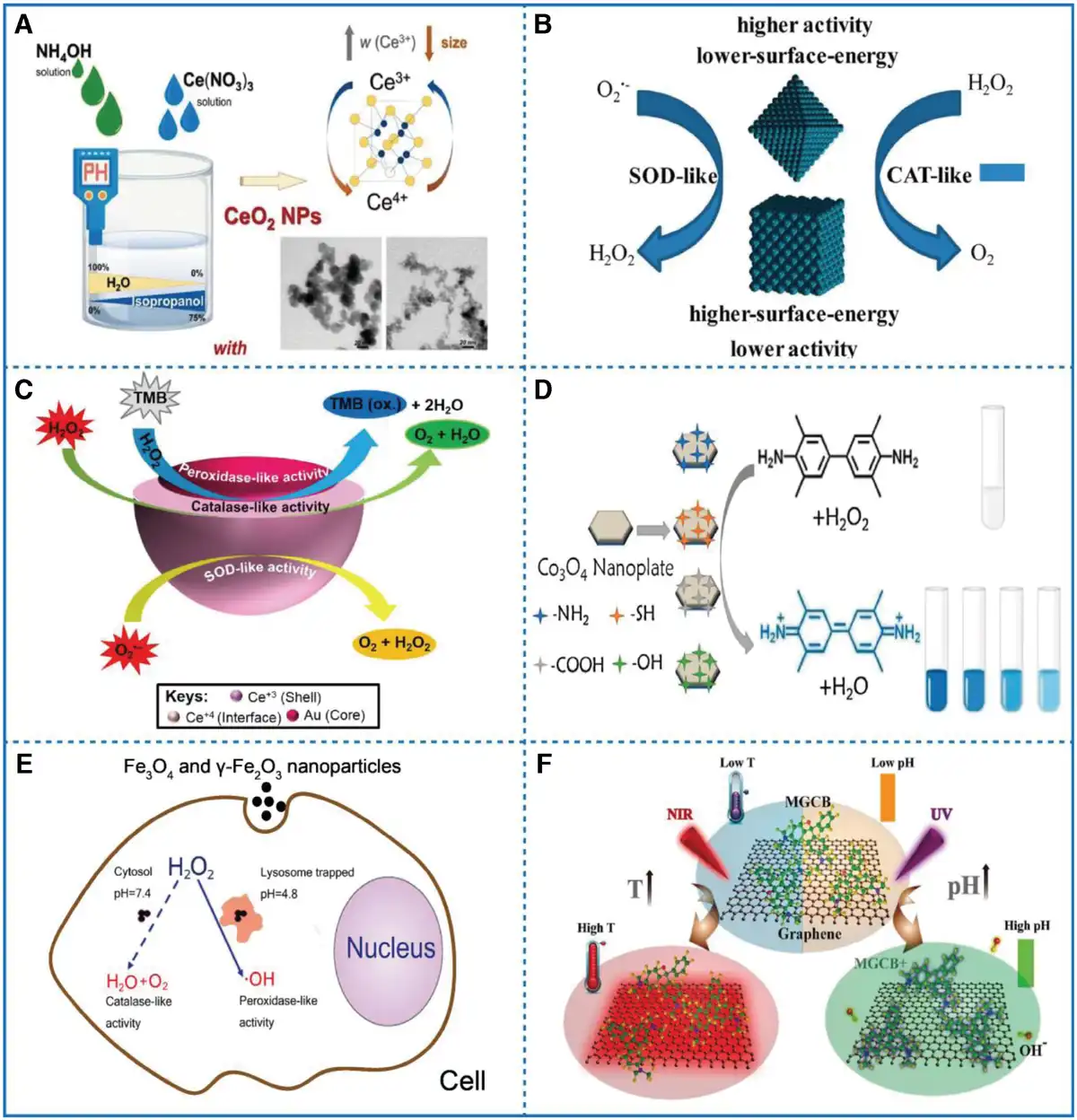
Figure 3.
(A) Synthesis and characterization schematic of cerium dioxide nanoparticles[61]. Copyright 2022, Elsevier. (B) Morphology, surface energy, and enzyme activity maps of palladium nanocubes and octahedrons[66]. Copyright 2016, American Chemical Society. (C) Enzyme-like activity of Au nucleus/Ce shell-based nanozymes[74]. Copyright 2018, Elsevier. (D) Surface modification of Co3O4 nanoplates as efficient peroxidase nanozymes for biosensing application[75]. Copyright 2021, American Chemical Society. (E) Fe3O4 and γ-Fe2O3 NPs exhibit enzymatic activity at different pH conditions[86]. Copyright 2012, American Chemical Society. (F) Photothermal effect of graphene and light-induced pH changing effect of MGCB[88]. Copyright 2017, American Chemical Society.
Xia et al.[62] explored the surface states and antioxidant activity of Ru NPs of different sizes and found that the proportion of the surface oxidized states increased significantly as the size of Ru NPs decreased. When the size was reduced to 2.0 nm, the surface oxidized Ru atoms of Ru NPs dominated, thus possessing an unprecedentedly boosted antioxidant activity as compared with medium-sized (≈3.9 nm) or large-sized counterparts (≈5.9 nm) that are mainly composed of surface metallic Ru atoms. The results suggest that size effect-mediated surface oxidation states can directly modulate the antioxidant activity of Ru NPs.
3.2.2 Morphology engineering
Morphology has an important effect on the catalytic activity of nanozymes, including crystallographic surface, surface cut, and surface energy, which affects their enzyme selectivity and reactivity[29,63]. For example, different morphologies of cerium-based nanomaterials (such as nanoclusters, nanoparticles, and nanoclains) were synthesized. Among them, cerium nanoclusters showed the highest level of SOD-like activity, and cerium nanoclusters showed higher SOD-like activity than CeNPs at cerium concentrations ranging from 5 to 100 mg/L. Similarly, among manganese-based nanozymes of different shapes (such as nanoflowers, plates, cubes, polyhedra, and hexahedra), flower-shaped Mn3O4 (with a specific surface area of up to 97.7 m2/g) exhibits the broadest catalytic activity, including CAT, GPx, and SOD-like activity, while other morphologies only exhibit SOD-like activity[64]. Ghosh et al.[65] synthesized 4 different morphologies of V2O5 NPs, such as nanowires, nanosheets, nanoflowers, and nanorods, and found that the rate of formation of peroxides on the surface affects their GPx-like activity. VO2 nanofibres were reported to have higher peroxidase-like activity compared with VO2 nanosheets and VO2 nanorods. Reported that (111)-faceted Pd octahedra with lower surface energy exhibited higher antioxidant activity than (100)-faceted nanocubes with higher surface energy (Figure 3B)[66]. Different morphologies of Co3O4 nanozymes exhibited different degrees of CAT-like activity in the order of Co3O4 nanoplates > Co3O4 nanorods > Co3O4 nanocubes[67]. In general, nanozymes with large specific surface area, including flower-like, nanoclusters, nanofibres, and mesopores, tend to exhibit higher enzyme activity.
3.2.3 Composition tuning
The catalytic activity of nanozymes can be modulated by adjusting the composition of the nanomaterials, which provides a variety of design strategies for optimizing the synthesis and performance of nanostructures[68]. For example, the overall activity can be enhanced by doping with other ions.
It is well known that the Ce3+/Ce4+ ratio affects the ability of CeO2 NPs to scavenge ROS. Doping is a successful and relatively simple strategy to improve the antioxidant capacity of CeO2. Researchers have developed CeO2 nanozymes by doping with different metal elements, including manganese, cobalt, silver, chromium, rhodium, palladium, and nickel. Gupta et al.[69] successfully synthesized La-, Sm-, and Er-doped CeO2, which controllably altered the ratio of Ce3+/Ce4+ and significantly improved the antioxidant properties of CeO2. In the study by Zhang et al.[70], the addition of Cr3+ increased the surface ratio of Ce3+/Ce4+, thus improving the catalytic activity of CeO2 nanozymes. Sun et al.[71] synthesized a series of halogen-doped CoCN, obtained CoCNF, CoCNCl, CoCNBr and CoCNI. We found the CAT, SOD, and GPx-like catalytic activities of CoCNCl, CoCNBr, and CoCNI significantly increased than that of CoCN. Especially, CoCNI exhibited the highest antioxidant capacity.
The reasonable design of bimetal or multimetal nanocomposites can help improve the catalytic properties of nanozymes. Wang et al.[72] reported a 1-step solvothermal synthesis of Au-doped Fe3O4 nanoparticles (Au@Fe3O4) with much higher catalytic activity than Au and Fe3O4 NPs. The catalytic performance and Raman scattering activity of AgAu, AgPd, and AgPt NPs were more pronounced than those of Ag NPs[73].
Adjusting the ratio of components and designing nanomaterials based on metal core/shell structures are both viable solutions to modulate enzyme-like properties. In general, gold nanoparticles alone do not exhibit SOD-like activity even at very high concentrations (300 µg/mL)[74]. However, Au core/Ce shell-based nanozymes (Figure 3C) exhibit SOD-like activity over a wide pH range (2–11) and at temperatures up to 90 °C.
3.2.4 Surface modification
Surface modification is another factor that highly influences the antioxidant activity, as most of the antioxidant reactions occur on the surface of nanomaterials. The main substances used for surface modification include polymers, biomolecules, small molecules, and ions, which can be modified to the surface of the material by physical adsorption or covalent coupling. In addition, different types of modifications can form coatings of different thicknesses, functional groups, and surface charges, which can affect the catalytic properties, stability, and substrate specificity of nanomaterials[68].
Huo et al.[75] modified Co3O4 nanoplates with the amino group (NH2-Co3O4), carboxyl group (COOH-Co3O4), hydroxyl group (OH-Co3O4), and sulfhydryl group (SH-Co3O4), respectively, and then systematically studied their catalytic activities (Figure 3D). Except hydroxyl group, the other functional groups all possessed positive effect to enhance POD-like activities, and among which the NH2-Co3O4 nanoplates ranked the first. The researchers considered that the functional groups’ influence on the electron transfer ability of nanozymes was critical to modulating their catalytic properties[29].
Ligands such as DNA, GSH, proteins, and dendritic polymers help to prevent the aggregation of metal nanoclusters, which enhances the equilibrium, biocompatibility, and enzyme activity of the nanozymes[76]. Yang et al.[77] successfully prepared polyethylene glycol (PEG)-modified single-atom nanozymes (Cu-SAzymes) with divalent Cu-N4 structure, and the results showed that PEG-modified Cu-SAzymes significantly improved the ability to scavenge intracellular O2 and effectively reduced oxidative DNA damage. Liu et al.[78] reported that PAMAM dendrimerised gold nanoclusters (AuNCs-NH2) terminated with amines unexpectedly lost POD-like activity under physiological conditions, but retained CAT-like activity. This may be due to the enrichment of polymeric tertiary amines, which exerted sufficient inhibitory effect on the key mediator -OH.
Meanwhile, poly tannic acid (PTA)-coated CeO2 nanoparticles exhibited more prominent SOD-like activity than untreated CeO2, which was attributed to the fact that the intrinsic reducing property of PTA might contribute to the enhancement of the Ce3+/Ce4+ ratio on the surface of CeO2, thus promoting the antioxidant activity[79]. CeO2 NPs (4.5 nm) were encapsulated into the cavities of the biomolecule apoferritin to form apoferritin-CeO2 nanoclusters[80]. The apoferritin coating improved the biocompatibility of the CeO2 NPs and controlled the electron localization on the surface of the nanomaterials, resulting in enhanced ROS-scavenging activity.
3.2.5 External stimuli
In addition to controlling the above factors, the activity of nanozymes can also be regulated by controlling conditions such as pH, light, and temperature. Several metal- and metal oxide-based nanozymes have been found to have enzyme-like activity in response to changes in pH and temperature[81]. For example, AuNPs exhibit the catalytic ability of peroxidase in acidic environments, while showing catalytic properties similar to SOD or CAT at alkaline pH[82]. Pt NPs[83], Ag NPs[84] have been reported to act as POD mimics under acidic conditions, while exhibiting CAT-like activity in neutral and alkaline environments. More importantly, Pt and Au NPs were shown to display SOD mimicry under neutral conditions[85]. Gao et al.[1] reported the POD-like activity of Fe3O4 NPs at pH 3.5. Chen et al.[86] reported that Fe3O4 and γ-Fe2O3 NPs exhibited CAT-like activity under neutral conditions (Figure 3E). Wu et al.[87] synthesized FeCO@C with OXD and POD-like activities. The OXD activity was strong at the pH of 3.6; however, it decreased significantly when the pH was increased to 4.4, while the POD activity increased.
Light is also used as an ideal external stimulus to regulate catalytic reactions. Xu et al.[88] selected the photothermal material graphene oxide (GO) and the photobase reagent malachite green carbinol base (MGCB) to construct a dual-responsive system (GO-MGCB), which can be temperature- and pH-modulated under UV and NIR irradiation. Studies have shown that temperature has a significant effect on the catalytic activity of copper-loaded tin oxide (SnO2-Cu) nanocomposites in POD mimicry reactions. The temperature range from 22 to 40 °C is where the color intensity and UV-visible absorption are highest. Beyond 40 °C, the absorbance starts to decrease and is lowest at 80 °C. Surprisingly, the maximum catalytic activity was observed at a modest temperature of 22 °C (Figure 3F). Varying the reaction parameters of the SnO2-Cu nanocomposites is important for this temperature-dependent behavior[89].
Photothermal effects and light-induced electron transfer have been shown to be the main sources of light-enhanced enzyme-like behavior of nanozymes[29]. For example, Researchers used AuNPs with α-FeOOH microcrystals formed on porous carbon to develop Au/α-FeOOH-FPC catalysts with visible-light-driven enzymatic properties[90]. By absorbing light energy, the AuNPs can emit heat, thereby increasing the system temperature to the desired level for the enzymatic process and accelerating the glucose oxidation reaction. In addition, hot electrons from the equipartitionally excited AuNPs promote charge separation at the Au/α-FeOOH interface, leading to the efficient cycling of Fe3+/Fe2+ to generate the Fenton reaction.
4. Nanozyme-mediated therapy for gastrointestinal inflammation
GI is a class of inflammatory lesions of the gastrointestinal mucosa driven by the excessive accumulation of ROS, immune dysregulation, and pathogen infection. It primarily includes the following clinical types. IBD is the core disease group in this field, comprising CD (which can affect any part of the digestive tract from the mouth to the anus, particularly the terminal ileum) and UC (where lesions are confined to the colon and rectum)[7,91]. Gastric mucosal inflammation (gastritis) is primarily triggered by H pylori infection, nonsteroidal anti-inflammatory drugs, or alcohol[92]. Small intestinal inflammation (enteritis) is associated with infectious pathogens, radiation exposure, or autoimmune abnormalities[93]. Special types of inflammation include celiac disease and eosinophilic gastroenteritis. Although these diseases have different pathogeneses, they share common features such as mucosal barrier disruption, inflammatory cell infiltration, and the release of proinflammatory cytokines (such as tumor necrosis factor [TNF]-α and IL-5). Epidemiological data indicate that the prevalence of IBD in developed countries has exceeded 0.3%, with incidence rates increasing at an annual rate of 5%[94]. Meanwhile, the infection rate of H pylori-associated gastritis in global approximately 50%[95], highlighting the significant public health burden of such diseases.
Currently, conventional drugs used for the regulation and treatment of GI are unable to achieve the desired therapeutic effect due to their poor tissue specificity, short duration of action with the lesion site, and low absorption rate. With the rapid development of nanotechnology, nanozymes, which have enzymatic reaction kinetic properties similar to those of natural enzymes, have demonstrated great potential for application in the therapy of GI. Nanozymes can achieve localized high-concentration drug release, precisely delivering drugs to the site of GI through targeted design, thereby exerting highly efficient effects in the inflamed area while reducing systemic drug distribution and effectively lowering systemic toxicity. Second, nanozymes possess long-circulation and sustained-release properties, enabling them to circulate in the body for extended periods and release drugs slowly, thereby prolonging the duration of drug action and enhancing therapeutic efficacy. These characteristics make nanozymes highly efficient, precise, and low toxicity in gastrointestinal treatment. Below, we will focus on the application of different types of nanozymes in the treatment of GI (Figure 4).
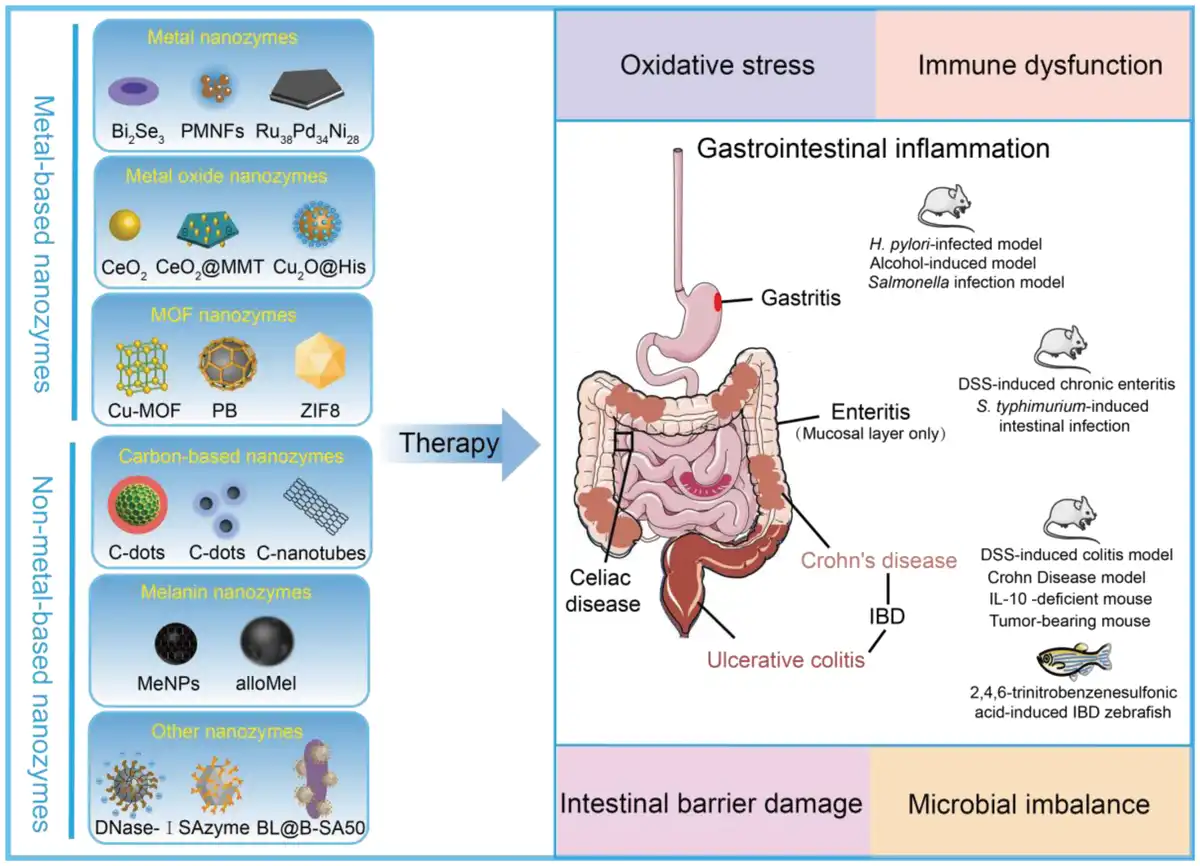
Figure 4.
Diagram showing various nanozymes used to treat gastrointestinal inflammation. Some elements created with Bioicons.com.
4.1 Metal-based nanozymes for GI
4.1.1 Metal nanozymes for GI
Metal-based nanozymes possess several advantages of easy preparation, special optical properties, excellent chemical stability under extreme conditions, and high biocompatibility[96–97–98]. As shown in Table 1, these nanozymes mimic natural enzymes by initiating and facilitating specific reactions and are capable of stable enzyme-like activity under physiological conditions[2]. Studies have shown that bismuth selenide 2-dimensional nanodisks (Bi2Se3) not only possess the ability to scavenge ROS and RNS but also regulate intestinal microbiota balance, increasing the abundance of Firmicutes and Actinobacteria while reducing the abundance of pathogenic Actinobacteria, thereby maintaining intestinal microbiota balance[99]. Halogen-doped modified single-atom cobalt catalysts (CoCN) exhibit exceptional antioxidant enzyme activity, significantly improving symptoms of colitis[71]. Zero-valent molybdenum nanoparticles, with their strong reducing capacity and acid stability, can effectively downregulate the NF-κB pathway, inhibit the overproduction of inflammatory factors, and alleviate intestinal oxidative damage[100]. Molybdenum selenide (Mo3Se4) nanosheets (PMNFs) exhibit multiple enzymatic catalytic activities, alleviating oxidative damage through the Nrf2-Keap1 signaling pathway while inhibiting the TLR4/NF-κB signaling pathway to reduce proinflammatory factor levels, thereby preventing damage to intestinal epithelial TJ proteins (ZO-1, occludin, and claudin-1), while downregulating Dextran Sulfate Sodium (DSS)-induced intestinal epithelial cell apoptosis[102]. Ultrafine rhodium nanoparticles (Rh-PEG NDs) possess multienzyme mimetic activity (eg, CAT) and high photothermal conversion efficiency, enabling them to scavenge ROS and RNS for the treatment of DSS-induced colitis and serve as photothermal agents for photothermal therapy of colorectal cancer[101].
Table 1
List of metal nanozymes, their enzyme mimetic activity, and efficacy study in GI.
| Nanozyme | Abbreviation for nanozymes | Enzyme-like activities | Test models | Schematic illustration of nanozyme for GI therapy | Preparation method | References |
|---|---|---|---|---|---|---|
| Lodine-doped monoatomic cobalt-anchored carbon nitride complexes | CoCNI | CAT, SOD, GPx | DSS-induced colitis model | Nanozyme treatment resulted in a significant increase in colon length and a significant decrease in inflammatory cell infiltration. | Self-assembly and pyrolysis process | [71] |
| PVP-modified bismuth selenide 2-dimensional nanodiscs | Bi2Se3 | Multiple RONS scavenging ability | DSS-induced colitis model | Bi2Se3 reduced body weight, splenic index, and proinflammatory cytokine levels as well as modulated intestinal flora in mice. | Hydrazine hydrate reduction method | [99] |
| Zero-valent-molybdenum nanodots | ZVMNs | Multiple ROS-scavenging ability | DSS-induced colitis model | ZVMNs were enriched in the intestine and inhibited the overproduction of inflammatory factors by downregulating the NF-κB pathway. | Mechanical exfoliation | [100] |
| Polyethylene glycol (PEG)-coated ultrasmall rhodium nanodots | Rh-PEG NDs | SOD, CAT | Tumor-bearing mouse and DSS-induced colitis model. | Decrease in the concentrations of TNF-α and IL-6, which resulted in excellent anti-inflammatory effects. | Aqueous phase reduction method | [101] |
| Transition metal chalcogenide (TMCs) nano flake and polyethylene glycol (PEG) modified Mo3Se4 nano flakes | PMNFs | CAT, SOD, POD, GPx | DSS-induced colitis model | PMNFs activate Nrf2-keap1 signaling and inactivate TLR4/NF-κB signaling to inhibit proinflammatory factors, prevent damage to intestinal epithelial tight junction proteins, and downregulate apoptosis in intestinal epithelial cells. | Hydrothermal method | [102] |
| Pluronic F-127-coated tungsten diselenide | WSe2@F127 | Multi-antioxidant enzyme-like activity | DSS-induced IBD model | WSe2@F127 nanozymes effectively alleviate IBD by reducing oxidative stress damage, modulating intestinal microbial populations, and remodeling the immune barrier. | Simple liquid-phase exfoliation | [103] |
| Ultrasmall tungsten-gallate nanodots | W-GA | SOD | DSS-induced acute colitis model | W-GA regulates the intestinal microbiome by inhibiting the abnormal expansion of Enterobacteriaceae during colitis and alleviating the damage caused by oxidative stress to the reconstructive microflora, ultimately restoring intestinal barrier function. | One-pot synthesis method | [104] |
| Procyanidin-free iron | Pc-Fe | POD, GPx | DSS-induced colitis model | Pc-Fe can scavenge ROS, inhibit inflammation, repair the gut barrier, and alternate the gut microbiome. | Solution stirring method | [105] |
| Tri-nickel tetrasulfide | Ni3S4 | SOD, CAT | DSS-induced IBD mouse model | Ni3S4 is capable of targeting inflamed intestines, reducing inflammation, repairing damaged intestinal barriers, restoring gut microbiota, and balancing the intestinal microenvironment. | Hydrothermal method | [106] |
| Au25 nanoclusters | Au25 NCs | SOD | DSS-induced colitis model | Au25 NCs can eliminate ROS, upregulate the expression level of antioxidant enzymes, inhibit the expression of proinflammatory cytokines, and finally interrupt the inflammatory circuit of IBD. | Solution Stirring Method | [107] |
| Ru38Pd34Ni28 ultrathin trimetallic nanosheets | TMNSs | SOD, CAT | DSS-induced colitis model; CT-26 tumor-bearing mouse model | TMNSs have RONS-eliminating properties to treat chronic colitis by relieving inflammation, as well as photothermal conversion capabilities. | Solvothermal method | [108] |
| Selenium-Based Nanozyme | GSH-Se | GPx | DSS-induced colitis model | GSH-Se on mouse colitis was likely mediated by the activation of the Nrf2/Keap1 (nuclear factor E2-related factor 2/Kelch-like ECH-associated protein 1) and GPx4 signaling pathways. | Hydrothermal method | [109] |
| MnNi@PVP Nanoenzyme | MnNi@PVP | SOD, CAT, GPx | DSS-induced colitis model | MnNi@PVP nanozyme with good RONS clearance and mucosal barrier recovery can enhance enteritis treatment. | High-temperature pyrolysis and NaCl template method | [110] |
| Taxifolin-iron nanozymes | Fe-Tax | SOD, CAT | Gastric ulcer mice model | Fe-Tax regulates the NRF2, NF-κB, Bax/Bcl-2, and VEGF signaling pathways, alleviating ethanol-induced tissue inflammation and gastric mucosal damage in gastric ulcers. | Solution Stirring Method | [111] |
| Ultrasmall iron-polyphenol nanozymes | UIPNs | SOD, CAT, POD | Alcohol-induced gastric mucosal mouse model | Sub-10 nm UIPNs can rapidly penetrate the gastric mucosa, remain in the stomach for more than 12 h, and remain stable in a highly acidic environment. They can prevent and protect against alcohol-induced gastric mucosal damage in mice. | Solution Stirring Method | [112] |
| Novel NPs incorporating Bi, CAT, and ABTS | Bi@CAT-ABTS NPs | CAT | Acute alcoholic gastritis mouse model | Precise localization of acute alcoholic gastritis through dual-mode photoacoustic/CT imaging by responding to H2O2 and H+ in the inflammatory microenvironment, while exerting long-lasting mucosal protection and anti-inflammatory repair functions. | Solution Stirring Method | [113] |
| Machine learning-screened nanozymes | SrDy2O4 | SOD, CAT | DSS-induced colitis model | SrDy2O4 exerted a therapeutic effect on UC by targeting the inflammatory site in the intestine, scavenging ROS, and reducing the inflammatory response. | Machine Learning-Assisted High-Throughput Screening Method | [114] |
ZVMNs, zero-valent molybdenum nanoparticles; DSS, Dextran Sulfate Sodium; RONS, reactive oxygen and nitrogen species.
Notably, tungsten diselenide nanocatalysts (WSe2@F127) achieve reactive oxygen/nitrogen species (RONS) scavenging through a rich valence state conversion mechanism involving elemental selenium (Se2+/Se4+) and tungsten (W4+/W⁶+), and specifically regulate intestinal microbiota and immune barriers via tungsten-mediated inhibition of Enterobacteriaceae and selenium-mediated T-cell differentiation[103]. Meanwhile, ternary metal nanosheets (Ru38Pd34Ni28, abbreviated as TMNSs) seamlessly integrate antioxidant therapy with photothermal therapy. By introducing different transition metal atoms into the ruthenium-palladium nanoplate structure, the formation of Ru-O and Ni-O bonds on the TMNS surface is promoted, and the abundant atomic vacancies in its surface design significantly enhance the clearance performance of ROS. TMNS can downregulate the expression levels of proinflammatory factors, thereby demonstrating significant therapeutic effects on DSS-induced colitis. Leveraging its excellent photothermal performance, TMNS can significantly inhibit CT-26 tumors without noticeable recurrence[108].
Some studies have shown that coordination polymer nanozymes based on natural antioxidant products and metal ions have promising applications in clinical translation for the treatment of GI. For example, proanthocyanidins (Pc) and free iron (Fe) coordinate to form a stable Pc-Fe nanozyme that mimics the activity of POD and GPx, exhibiting excellent antioxidant capacity and ROS-scavenging ability in vitro. Further in vivo studies revealed that inflammation regulation and gut microbiota regulation may be the potential mechanisms underlying the good therapeutic effects of the Pc-Fe nanozyme on the DSS-induced colitis model, particularly in terms of downregulating proinflammatory cytokines, reducing inflammatory cell infiltration, and restoring gut microbiota dysbiosis[105]. Another innovative research and development project involved ultrasmall tungsten-gallic acid (W-GA) nanodots, which precisely regulate the intestinal microbiota by inhibiting the abnormal proliferation of Enterobacteriaceae bacteria during colitis, thereby promoting the restoration of the intestinal barrier. These nanodots integrate microbiota reprogramming and mitigate the damage caused by oxidative stress to the reconstruction of bacterial communities, demonstrating good therapeutic effects on IBD[104].
Taxifolin-iron nanozymes (Fe-Tax) effectively remove reactive oxygen and nitrogen species in the gastrointestinal tract by mimicking SOD and CAT, thereby alleviating oxidative damage, inflammatory responses, and cell apoptosis. Additionally, Fe-Tax could alleviate tissue inflammation and gastric mucosal damage by regulating NRF2, NF-κB, Bax/Bcl-2, and VEGF signal pathways in ethanol-induced gastric ulcer[111]. Using fully edible natural active polyphenols, iron ions, and polyvinylpyrrolidone, sub-10 nm ultrasmall iron-polyphenol nanozymes (UIPNs) were synthesized (Figure 5A). UIPNs rapidly penetrate the gastric mucosa, remain in the stomach for over 12 hours, and maintain stability in a strongly acidic environment. They exhibit outstanding enzymatic activity for CAT, POD, and SOD, and demonstrate excellent performance in preventing and protecting against alcohol-induced gastric mucosal damage in mice[112]. These studies collectively demonstrate that the synergistic coordination of polyphenols (such as proanthocyanidins and quercetin) with metal ions (Fe/Cu/Mn, etc) not only preserves the high catalytic activity of metal nanozymes but also reduces the toxicity of metal ions through natural antioxidant ligands, thereby enhancing their biocompatibility. This provides an innovative solution for the clinical treatment of GI disorders.
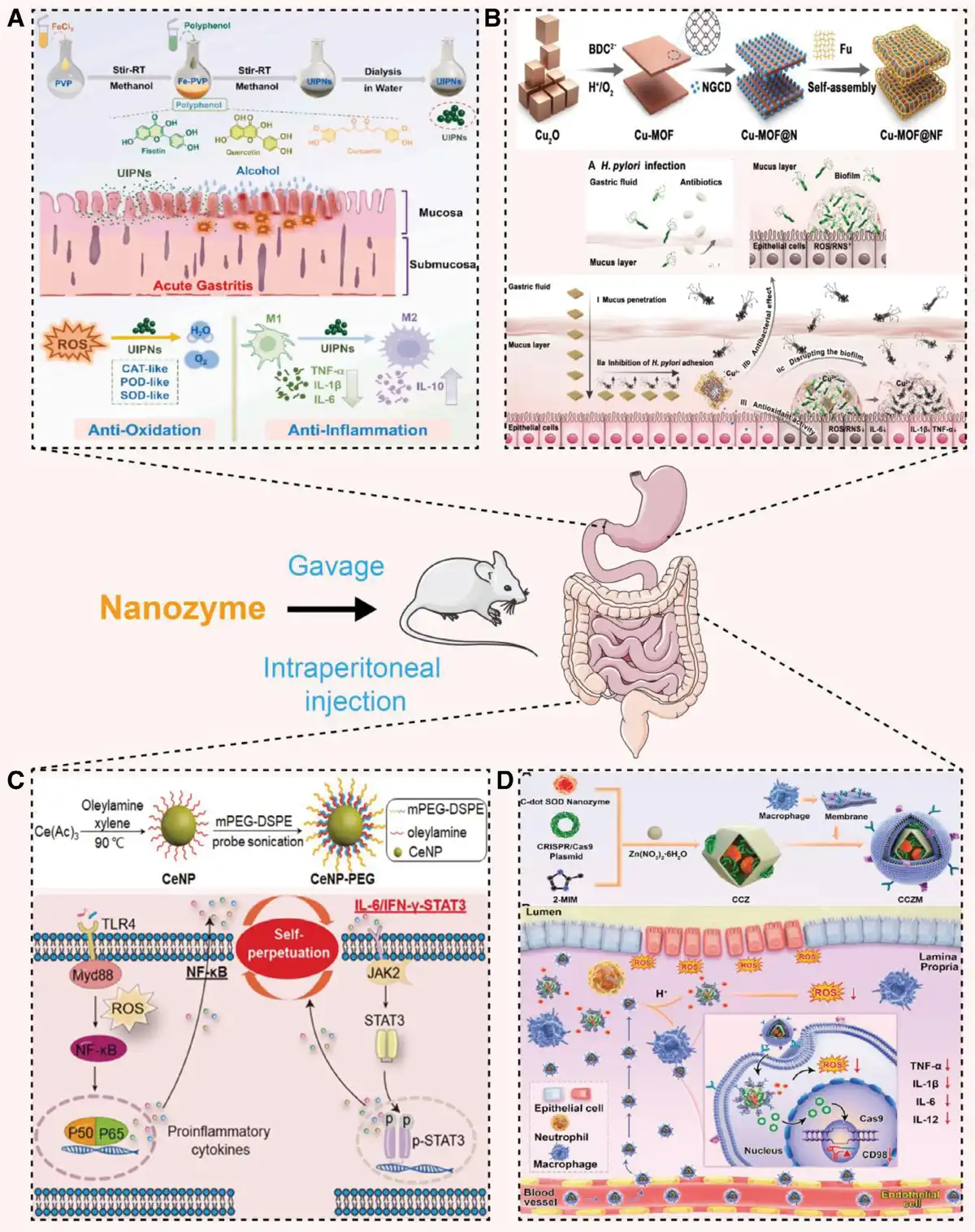
Figure 5.
Application of metal-based nanozymes in GI. (A) The preparation process of ultrasmall iron-polyphenol nanozymes (UIPNs) and the prevention and protection mechanisms of UIPNs for alcohol-induced acute gastritis in mice[112]. Copyright 2024, Chemical Engineering Journal. (B) Schematic illustration of the fabrication process and curative action of Cu-MOF@NF in H pylori infection[148]. Copyright 2024, Research. (C) Synthesis of cerium nanoparticles (CeNP-PEG) and their proposed signaling pathways for self-maintenance of the proinflammatory microenvironment in IBD[116]. Copyright 2022 BMC. (D) Schematic illustration of the synthesis and application of biomimetic MOFs (CCZM) for ulcerative colitis treatment[145]. Copyright 2022, American Chemical Society. Some elements created with Bioicons.com.
4.1.2 Metal oxide nanozymes for GI
Due to its dynamic and reversible Ce3+/Ce4+ redox pair and abundant oxygen vacancies, CeO2 exhibits catalytic activities for a variety of enzymes, such as SOD, CAT, POD, OXD, and phosphodiesterases[115], and thus shows great potential for applications in disease diagnosis and therapy (Table 2).
List of metal oxide nanozymes, their enzyme mimetic activity, and efficacy study in GI.
| Nanozyme | Abbreviation for nanozymes | Enzyme-like activities | Test models | Schematic illustration of nanozyme for GI therapy | Preparation method | References |
|---|---|---|---|---|---|---|
| Polyethylene glycol (PEG)-capped ceria nanoparticles | CeNP-PEG | Multiple ROS-scavenging ability | DSS-induced colitis model | ROS-scavenging downregulating of proinflammatory cytokines and detaining the proinflammatory potential in macrophages and Th1/Th17 response. | Nonhydrolysable sol-gel reactions | [116] |
| Chitosan-coated CeO2 nanozyme | CCNZ | SOD, CAT | DSS-induced ulcerative colitis model | Nanozyme hydrogel exhibits multiple functions, including inflamed site targeting, supporting cell growth, ROS scavenging, and antibacterial activity. | NH4OH precipitation method | [117] |
| Gold nanoparticles-embedded ceria nanoparticles | Au/CeO2@HA | SOD, CAT | DSS-induced colitis mouse | Nanozyme facilitates accumulation in inflamed colon tissues, reduces proinflammatory cytokines, and effectively alleviates colon injury. | Self-reduction method | [118] |
| Ceria nanozymes | PEG-CNP | SOD, CAT | DSS-induced ulcerative colitis model | PEG-CNPs promoted intestinal epithelial cell healing, inhibited proinflammatory macrophage activation, and activated the Nrf2/ Keap1 signaling pathway to scavenge ROS. | Modified reverse micelle method | [119] |
| Situ growth of CeO2 onto montmorillonite (MMT) | CeO2@MMT | SOD, CAT | DSS-induced IBD model | Nanozyme regulated local immunological region of lesion by downregulating proinflammatory cytokine levels with concomitant upregulating anti-inflammatory cytokine levels. | Situ growth method | [120] |
| Dextran-coated cerium oxide nanoparticles | Dex-CeNP | Multiple ROS-scavenging ability | DSS-induced colitis model | Nanozymes can be enriched at sites of intestinal inflammation for CT imaging of inflammatory spots in the gastrointestinal tract. | Precipitation method | [121] |
| Nanoceria and curcumin (Cur) to mannose-modified chitosan (MCS) | Ce-Cur@MCS | SOD, CAT | DSS-induced colitis model | Ce-Cur@MCS maintains the efficacy of IBD by inhibiting macrophage-induced inflammation, suppressing ferritin deposition in intestinal cells, and increasing the abundance and diversity of the intestinal microflora. | Self-assembled method | [122] |
| Inulin (IN)-coated cerium oxide nanoparticles | CeO2@IN NPs | SOD, CAT | DSS-induced colitis model | CeO2@IN NPs exhibited excellent gastrointestinal stability and colitis-targeting, ROS scavenging, and CT imaging capacities. | Precipitation method | [123] |
| Enteric-coated cerium dioxide nanoparticles | CeO2@S100 | SOD, CAT | DSS-induced colitis model | CeO2@S100 significantly alleviates the IBD by balancing oxidative stress and regulating gut microbiota | Single-emulsion evaporation method | [124] |
| Integration of MyD88 inhibitor into mesoporous cerium oxide nanozymes | TJ-5/MCN | SOD, CAT | DSS-induced colitis model | Nanozymes achieve synergistic treatment of colitis by scavenging ROS and modulating inflammatory responses. | Coincubating method | [125] |
| Situ growth of CeO2 nanozymes on probiotic spores | Ces3 | SOD | S typhimurium-infected mouse model of acute gastroenteritis | Nanozymes have the ability to improve intestinal microbiota dysbiosis and repair mucosal barrier function. | Situ growth method | [126] |
| Manganese oxide nanozymes | Mn3O4 | SOD, CAT | DSS-induced IBD model | Nanozymes can remove ROS produced by inflammatory macrophages while reducing the inflammatory cytokine IL-1β. | Solventthermal method | [127] |
| Hollow mesoporous manganese dioxide nanozyme carriers loaded with Bud | MPDB NPs | SOD, CAT | DSS-induced colitis model | Nanozymes can target inflammatory macrophages and inhibit inflammation in intestinal tissues through the synergistic anti-inflammatory effect of drugs and nanozymes. | Acid etching method | [128] |
| Histidine-functionalized Cu2O | Cu2O @His | SOD, CAT | DSS-induced colitis model | With its small size and large specific surface area, Cu2O@His has excellent RONS scavenging ability. Importantly, it can target mitochondrial sites and repair damaged mitochondria. | Precipitation method | [129] |
| Li-doped samples Zn1-xLixMn2O4 (x=0, 0.2, 0.4, 0.6, 0.8, and 1) | LM | SOD, CAT, GPx | DSS-induced IBD in mouse | Downregulation of TNF-α and upregulation of IL-10 and overall improved colon healing and health. | Hydrothermal method | [130] |
| Manganese-based nanoparticles | Mn3O4 NPs | SOD, CAT, GPX | Healthy male Kunming mice | Low doses of Mn3O4 enhance the antioxidant function of the colon. High doses of Mn3O4 cause oxidative damage and mucosal damage to the colon of mice, while also altering the proportion of the fecal microbiota. | Solventthermal method | [131] |
| ZnO-Cu/Mn nanozyme | ZnO-CM | POD, SOD, CAT | Salmonella infection in mice | ZnO-CM can efficiently inhibit bacterial growth, alleviate inflammation, and restore the intestinal barrier, resulting in good antibacterial and anti-inflammatory effects on Salmonella-induced colitis. | Simple hydrothermal method | [132] |
| Copper/Carbon Hybrid Nanozyme | CuO-HCSs | POD, CAT, SOD | S typhimurium intestinal infection mouse model | Nanozymes reveal metal state-dependent multienzyme activity and differential antibacterial mechanisms. Cu2+-dominant enzymes destroy Gram-negative bacteria through ion release, while Cu⁰-dominant enzymes rely on enzyme catalysis to produce ROS for broad-spectrum antibacterial activity. | Solution Method | [133] |
DSS, Dextran Sulfate Sodium; MPDB NPs, Bud-loaded hMnO2/Poly(allylamine hydrochloride)/DSS nanoparticles; RONS, reactive oxygen and nitrogen species.
In the treatment of IBD, Zeng et al.[116] synthesized biocompatible drug-free CeO2 nanozymes (CeNP-PEG) with regenerative scavenging activity of multiple ROS. Administration of CeO2 nanozymes alone could inhibit inflammatory macrophages and the corresponding NF-κB and JAK2/STAT3 costimulatory pathways to reduce the level of ROS in the intestinal microenvironment and downregulate inflammatory cytokine secretion, thus exerting a therapeutic effect on intestinal inflammation (Figure 5C). To improve the retention of CeO2 nanozymes in the intestinal tract and thus enhance their therapeutic effects, Cheng et al.[117] encapsulated CeO2 nanozymes in a gel electrostatically assembled with chitosan and alginate. Since the positively charged protein aggregation at the colitis lesion makes the site positively charged, the negatively charged nanozymes can be aggregated in large quantities at the colitis lesion to improve the retention effect, which not only enhances the removal of ROS by CeO2 nanozymes from the lesion but also makes the gel have a certain effect on the repair of intestinal mucosal damage. Li et al.[118] embedded gold nanoparticles in CeO2 through the self-reduction reaction between chloroauric acid and Ce3+ in ammonia solution. Synthesized hybrid nanoparticles (Au/CeO2) possessed higher anti-inflammatory and antioxidant activities than the commercial CeO2 nanozymes due to the exposure of catalytic sites, Ce (III), and oxygen vacancies by the unique porous core-shell structure. By further modifying negatively charged hyaluronic acid on the surface of Au/CeO2, the nanoparticles could be effectively enriched in the inflammatory foci of the intestinal tract. Thereby enhancing the anti-inflammatory and antioxidant effects of nanoenzymes and downregulating the production of proinflammatory cytokines. Zhang et al.[119] synthesized CeO2 nanozymes PEG-CNPs with multienzyme activity using a modified reverse micellar method. After intravenous injection, they can be targeted and enriched in the inflamed colon region through the EPR effect, exerting the following therapeutic effects: (1) By scavenging ROS and generating O2, they downregulate the expression of HIF-1α in macrophages and intestinal epithelial cells, thereby inhibiting the activation of proinflammatory macrophages and reducing inflammatory factor levels. (2) They promote the expression of TJ proteins, repairing the damaged intestinal mucosal barrier. (3) Activating the Nrf2/Keap1 signaling pathway, upregulating antioxidant genes (Nqo1, Gpx1, and HO-1) and downregulating pro-oxidative genes (Nox2 and Cyp2e1), thereby enhancing tissue antioxidant capacity. These synergistic effects collectively promote the alleviation and repair of colitis. Zhao et al.[120] grew CeO2 nanoparticles on clinically approved montmorillonite (MMT) in situ, and by optimizing the doping ratio, the synthesized CeO2@MMT (w:w = 1:9) could stably pass through the stomach. Since CeO2 nanoparticles have catalytic activities and can eliminate hydroxyl radicals, and the negatively charged MMT can be enriched at the inflammatory sites of the intestinal tract, the synthesized CeO2@MMT composites can improve the therapeutic effect of IBD.
In addition to its anti-inflammatory therapeutic effect, CeO2 also produces strong X-ray attenuation, which can be used for computed tomography (CT) imaging. Based on this, Naha et al.[121] obtained Dex-CeNP by precipitating cerium salts in dextran-containing ammonia solution and encapsulating CeO2 nanoparticles with dextran. The nanoparticles can be enriched at the site of intestinal inflammation by electrostatic interactions for CT imaging of inflammatory sites in the gastrointestinal tract, and the experimental results showed that Dex-CeNP has superior imaging characteristics to iodoisophthalic alcohol, which is a clinically approved contrast agent. Combined with the anti-inflammatory ability of Dex-CeNP, it can be used for CT imaging-guided IBD treatment.
The targeting ability and inhibition of oxidative stress possessed by CeO2 nanozymes have also been used to realize the therapeutic potential of probiotics to ameliorate gut microbiota dysbiosis and repair mucosal barrier function. Ces3 was synthesized by in situ growth of positively charged CeO2 nanozymes on probiotic spores, which promote electrostatic interactions with negatively charged pathogens and have high ROS-scavenging activity. Importantly, Ces3 showed high resistance in Salmonella typhimurium-infected mice with acute gastroenteritis. Due to its O2 deprivation ability, Ces3 also promotes the proliferation of anaerobic probiotics, remodeling a healthy gut microbiota[126].
Manganese oxide has multiple valence states of manganese, as well as oxidizing and reducing ability, and therefore has SOD, CAT, and GPx enzyme activities, which can be used in the treatment of GI.
For example, Cheng et al.[127] synthesized Mn3O4 nanozymes modified with DSPE-PEG using a hydrothermal method in an oleamine solution. Mn3O4 nanozymes with SOD and CAT catalytic activity contain both Mn2+ and Mn3+ oxidation states, which can scavenge ROS produced by inflammatory macrophages while reducing the levels of inflammatory cytokines such as IL-1β. Therefore, they demonstrated better therapeutic effects than the clinical drug 5-aminosalicylic acid in mouse UC and CD models. Qiu et al.[128] also developed the anti-inflammatory drug budesonide (Bud) loaded in hollow manganese dioxide nanozymes (hMnO2) by acid etching to form the so-called Bud-loaded hMnO2/Poly(allylamine hydrochloride)/DSS nanoparticles nanozymes, which can target inflammatory macrophages and inhibit inflammation in intestinal tissues through the synergistic anti-inflammatory effect of the drug and the nanozymes, thus effectively treating IBD. Studies have shown that the effects of Mn3O4 nanoparticles in the intestine are dose-dependent. Continuous oral administration of low doses (125 mg/kg) of Mn3O4 nanoparticles for 20 days resulted in increased expression of antioxidant gene mRNA in the colon of mice, thereby enhancing the colon’s antioxidant function. Conversely, administration of high doses (250 mg/kg) of Mn3O4 nanoparticles resulted in oxidative damage and mucosal injury in the colon of mice, accompanied by an increased ratio of Firmicutes to Bacteroidota in the fecal microbiota[131].
Ultrasmall particles of Cu2O@His developed using histidine (His) exhibited excellent RON scavenging ability[129]. His endowed Cu2O@His with more negative charge on the surface of Cu2O, resulting in good dispersion of Cu2O@His. Notably, the ultrasmall size of Cu2O@His reduced in vivo toxicity in mice and facilitated the enrichment of inflammatory sites via electrostatic interactions. Further mechanistic validation showed that Cu2O@His has a higher reduction potential and fewer oxygen vacancies. These favorable factors constitute the excellent enzyme-like activity of Cu2O@His. In vitro experiments demonstrated that Cu2O@His could be enriched into mitochondria, restore the membrane potential, scavenge intracellular ROS, and reduce inflammatory factors (IL-6 and TNF-α).
Study developed a copper/manganese codoped zinc oxide nanozyme (ZnO-CM) for the treatment of Salmonella-induced colitis[132]. The nanozyme exhibits pH-responsive properties, displaying POD activity under acidic conditions and SOD/CAT activity in neutral environments. Experiments confirmed that ZnO-CM effectively inhibits Salmonella growth by scavenging ROS, upregulating TJ proteins (occludin/claudin-1), and reducing the expression of proinflammatory factors (IL-1β/IL-6), thereby significantly improving intestinal inflammation and barrier function. This smart nanozyme provides a new approach for the treatment of bacterial enteritis.
4.1.3 Metal-organic frameworks for IBD
MOFs are porous hybrid materials composed of metal ions/metal clusters and organic ligands. The excellent properties of MOFs, such as structural tunability, functional group richness, large specific surface area, and high thermal stability, have driven the research on their applications in biomedical fields[2,73,134]. In GI treatment applications, MOF materials mainly exert their effects through 2 strategies. The first is as nanocatalysts with intrinsic enzyme activity, and the second is as multifunctional carriers for delivering therapeutic drugs or active substances (Table 3).
Table 3
List of MOFs nanozymes, their enzyme mimetic activity, and efficacy study in GI.
| Nanozyme | Abbreviation for nanozymes | Enzyme-like activities | Test models | Schematic illustration of nanozyme for GI therapy | Preparation method | References |
|---|---|---|---|---|---|---|
| Metal-organic framework (MOF) nanozymes with different ligands | MIL-47(V)-X MOFs (X = F, Br, NH2, CH3, OH, H) | GPx | DSS-induced colitis model | Nanozymes can be used as ROS scavengers in vitro to protect cells from oxidative damage. In vivo it has a broad-spectrum anti-inflammatory effect against otitis and colitis. | A ligand engineering | [135] |
| Introducing Mn (III) porphyrin and Pt NP into a nanoscale Zr-based MOF (PCN222) | Pt@PCN222-Mn | SOD, CAT | DSS-induced IBD model | MOF-based nanozymes have excellent ROS-scavenging activities for in vivo inflammatory treatment. | Solvothermal methods | [136] |
| Ruthenium-based metal-organic framework | Ru-MOF | SOD, CAT | DSS-induced colitis model | Ru-MOF effectively scavenges ROS, protects cells from oxidative stress, effectively attenuates colon damage in mice, and exhibits efficient and stable catalytic activity in vitro. | Hydrothermal method | [137] |
| Manganese metal organic framework | Mn-MOF | CAT | Interleukin 10 (IL-10)-deficient mice | Mn-MOF can effectively remove excessive ROS produced by neutrophils and macrophages, relieve oxidative stress, reduce inflammatory response and restore the intestinal barrier. | Hydrothermal method | [138] |
| Sul-loaded Mn doped prussian blue nanoparticles | Sul-MPBs | SOD, CAT, GPx | DSS-induced acute colitis model | Sul-MPBs improve cellular energy dysfunction, inhibit apoptosis, and have a strong ability to alleviate IBD inflammation and balance immunity. | One-pot synthesis method | [139] |
| Manganese Prussian blue nanozymes | MPBZs | Multi-antioxidant enzyme-like activity | DSS-induced colitis mouse | Nanozymes preferentially accumulate at inflamed mucosa in colitis areas and significantly improve colitis, a primary effect on the TLR signaling pathway. | Hydrothermal method | [140] |
| Manganese-Iron Prussian Blue | MnPB | SOD, CAT | DSS-induced acute UC mouse models | The ability of the nanozymes to protect cells from ROS attack and to effectively improve pathological symptoms in a UC mouse model resulted in a reduced inflammatory response and improved survival. Notably, large-scale production of nanozymes yielded an unprecedented ≈11 g per reaction batch. | Solvothermal methods | [139] |
| Curcumin (CCM) decorated on cobalt-iron doped Prussian blue analog (PBA) | CCM-CoFe PBA | SOD, CAT, POD | DSS-induced UC model | CCM-CoFe PBA converted M1 macrophages to M2 macrophages, inhibited proinflammatory factors, and significantly reduced the symptoms of colitis in mice. | Stirring method | [141] |
| Azido (N3)-modified Prussian blue nanozyme and dibenzocyclooctyne (DBCO)-modified Lactobacillus reuteri DSM 17938 | PB@N3 and LR@DBCO | CAT, POD | DSS-induced colitis model | The combination of PB@N3 and LR@DBCO enhances the colonization of probiotics, modulates intestinal flora composition and function, regulates immune profiles, restores intestinal barrier function, and alleviates intestinal inflammation. | Solvothermal method | [142] |
| Zero-valence selenium-enriched Prussian blue nanozymes | Se-HMPB | SOD, CAT, GPx | DSS-induced IBD model | Se-HMPB nanozymes can effectively scavenge ROS and protect the integrity of the intestinal mucosal barrier, reducing the differentiation of inflammatory cells and the expression of inflammatory cytokines. | Hard template method | [143] |
| Yeast cell wall (YCW) as the outer shell and zinc-doped Prussian blue analogue (ZnPBA) nanozyme inside | ZnPBA@YCW | SOD, CAT, POD | DSS-induced colitis model | ZnPBA nanozymes reduce lipid peroxidation by effectively scavenging ROS, inhibit the NF-κB signaling pathway, reduce the secretion of inflammatory factors TNF-α and IL-6, and also regulate intestinal flora disorders. | Simple extrusion method | [144] |
| C-dots and CD98 CRISPR/Cas9 plasmid were encapsulated into MOF carrier, and then camouflaged with macrophage membrane | CCZM | SOD | DSS-induced UC model | This bionic system is simultaneously pH-responsive, immune escape, and inflammation-targeting. CCZM significantly abrogated ROS and downregulated CD98, significantly improving inflammatory symptoms, including colon length, epithelial integrity, and inflammatory response in mice. | A one-pot approach | 145] |
| Codoped zeolitic imidazolate framework to load curcumin | CCM-Co-ZIF-8 | SOD, CAT, POD | DSS-induced colitis model | CCM-Co-ZIF-8 eliminates ROS, enables macrophage subtype transformation (M1 to M2), and inhibits the expression of proinflammatory cytokines to regulate macrophage polarization. | Solution stirring method | [146] |
| Zinc ions were combined with tannic acids | HZn-TA | Multi-antioxidant enzyme-like activity | DSS-induced acute intestinal inflammation | HZn-TA reduces intestinal inflammation in mice by decreasing colonic injury, proinflammatory cytokine levels, splenic index, and body weight. It also promoted intestinal mucosal healing and upregulated the expression of ZO-1 and claudin-1. | One-pot method | [147] |
| Copper-bearing metal-organic framework (Cu-MOF) loaded with nitrogen-doped carbon dots | Cu-MOF@NF | Scavenge O2•−, •OH, and •NO | H pylori-infected mouse model | Cu-MOF@NF can not only penetrate the gastric mucus barrier to block bacterial adhesion, but the Cu2+ it releases can also effectively degrade biofilm polysaccharides and disrupt the bacterial life cycle. | Solution stirring method | [148] |
DSS, Dextran Sulfate Sodium.
By carefully selecting metal centers and organic ligands, MOF materials with specific enzyme-mimicking activity can be constructed. For example, functionalization of ligands in the MIL-47(V) series of MOFs by introducing different substituents (such as -NH2, -OH) can significantly regulate their GPx-like activity, with the amino-modified MIL-47(V)-NH2 exhibiting excellent biocompatibility and ROS-scavenging ability[135]. More complex systems, such as the PCN222-Mn/Pt composite material constructed by combining Mn(III) porphyrin ligands with Pt nanoparticles, achieve cascading catalytic effects of SOD and CAT, efficiently converting into harmless water and oxygen, and effectively protecting mice from ROS-related IBD[136]. Additionally, ruthenium-based MOFs (Ru-MOFs) integrate the catalytic properties of tris(phenylphosphine)ruthenium dichloride, demonstrating broad-spectrum ROS-scavenging capacity and stable multienzyme activity, showing significant therapeutic effects in DSS-induced colitis models[137]. Addressing the challenge of H pylori gastritis infection, the innovative Cu-MOF@NF platform is loaded with nitrogen-doped carbon dots and fucoidan (Figure 5B). Not only can it penetrate the gastric mucus layer and prevent H pylori from adhering to gastric mucosal epithelial cells, but the released Cu2+ can also effectively degrade biofilm polysaccharides and disrupt the cyclical growth pattern of “bacterial plankton-biofilm,” thereby preventing recurrent and persistent infections[148].
Prussian blue (PB) and its analogues are a common class of MOFs with antioxidant enzyme activity, consisting of trivalent iron and ferrous iron coordinated with cyanide, which are biocompatible and biosafe. PB NPs have catalytic properties similar to those of POD-, CAT, and SOD, which may be attributed to interconversions between the different valence states of Fe, which make PB NPs good electron transporters[149]. Based on the PB framework, researchers have developed various functionalized nanozyme systems. Manganese-doped PB nanoparticles (MPBs) not only retain the multienzymatic activity of PB but also serve as drug carriers for loading the anti-inflammatory drug sulfasalazine. This nanomaterial system improves cellular energy dysfunction, inhibits apoptosis, and exhibits strong anti-inflammatory and immune-balancing capabilities in IBD[139]. Selenium-doped PB (Se-HMPB) introduces selenium with GPx-like activity, effectively inhibiting iron-dependent cell death in UC treatment and regulating Th1 cell differentiation in CD treatment, thereby effectively protecting the integrity of the intestinal mucosal barrier[143]. Notably, the ZnPBA@YCW oral delivery system, formed by PB analogues using yeast cell walls as carriers, specifically targets pathogenic Escherichia coli, eliminating pathogens while regulating intestinal microbiota balance. It also reduces inflammatory responses by inhibiting the NF-κB signaling pathway, achieving synergistic effects through multiple therapeutic mechanisms[144].
In addition, MOF, as a framework material, can deliver nanozymes or actives for site-specific treatment of GI. By co-encapsulating carbon dots (named as CNs) with SOD activity and CD98 CRISPR/Cas9 plasmids (named as CPs) within ZIF-8nanoparticles (termed as CCZ) enveloped by macrophage membranes, the constructed CCZM system exhibits acid-responsive release, immune evasion, and inflammation-targeting properties. It effectively clears ROS at the lesion site and downregulates the expression of the inflammation-related biomarker CD98, significantly improving inflammatory symptoms in mice, including colon length, epithelial integrity, and inflammatory response, thereby achieving a synergistic therapeutic effect (Figure 5D)[145]. Similarly, the CCM-Co-ZIF-8 composite material formed by cobalt-doped ZIF-8 loaded with curcumin not only possesses multiple ROS-clearing enzyme activities (POD, CAT, and SOD) but also promotes the polarization of macrophages from proinflammatory M1 type to anti-inflammatory M2 type, effectively regulating the immune microenvironment[146]. Cobalt-doped ZIF-8 loaded with tannic acid forms tannic acid-zinc nanoparticles (HZn-TA), which alleviate intestinal inflammation in mice with acute colitis by reducing colonic damage, proinflammatory cytokine levels, spleen index, and body weight. It also promotes intestinal mucosal healing by upregulating the expression of TJ proteins ZO-1 and claudin-1[147].
4.2 Nonmetal-based nanozymes for GI
4.2.1 Carbon-based nanozymes for GI
Carbon-based materials are rich in surface functional groups and have many unsaturated structures, leading to a large number of active sites and multiple enzyme activities[26,150]. Carbon-based nanozymes are highly biocompatible, relatively stable in living organisms, easy to be functionally modified, and widely used in GI therapy (Table 4).
Table 4
List of carbon-based nanozymes, their enzyme mimetic activity, and efficacy study in GI.
| Nanozyme | Abbreviation for nanozymes | Enzyme-like activities | Test models | Schematic illustration of nanozyme for GI therapy | Preparation method | References |
|---|---|---|---|---|---|---|
| Carbon dots | C-dots | SOD | DSS-induced colitis mouse; TNBS-induced Crohn’s mouse | C-dots can reduce the expression of proinflammatory cytokines TNF-α, IL-6, IL-1β. It can effectively alleviate colonic inflammation, including reduced colon length, epithelial damage, inflammatory cell infiltration and overexpression of proinflammatory cytokines. And it has good fluorescence properties for in vivo imaging. | Solvothermal method | [151] |
| Carbon dots | C-dots | SOD | DSS-induced colitis model | C-dots nanozymes protects cells from oxidative stress, reduces the expression of proinflammatory cytokines, and also shows significant ability to modulate the composition of the gut microbiota. | Solvothermal method | [152] |
| Metal-free carbon dots | CP-CDs | SOD | DSS-induced colitis model | CP-CDs have good free radical scavenging ability and restoration of intestinal barrier. Downregulation of inflammatory cytokines in the NLRP3 pathway and rebalancing of DSS-damaged intestinal flora are its 2 main therapeutic mechanisms. | Hydrothermal method | [153] |
| Iodine-copper-zinc covalent doped carbon dots | Cu,Zn,I-CDs | SOD, CAT, GPx | DSS-induced colitis model | Cu,Zn,I-CDs scavenged excess ROS, reduced the expression of proinflammatory cytokines (eg, TNF-α, IL-1β, and IL-6), and effectively alleviated colonic inflammation in mice. | Microwave digestion system | [154] |
| Macrophage-biomimetic liposomes delivery of carbon dots nanozymes | C-dots@Lipo-M | SOD | DSS-induced UC model | C-dots@Lipo-M can be guided by macrophage membranes to be delivered to sites of inflammation and can also alleviate intestinal inflammation by modulating inflammatory pathways and remodeling the redox microenvironment. | Thin-film hydration method | [155] |
| Hollow porous carbon spheres codoped with nitrogen and iron | Fe/N-HCNs | POD, OXD, CAT, SOD | DSS-induced colitis model | Fe/N-HCNs with the ability to scavenge ROS in a neutral environment can also be used to treat noninfectious IBD. | One-step method | [156] |
| Fullerenol nanoparticles | FNPs | POD | H pylori mouse model | FNPs efficiently catalyze the production of ROS under low pH conditions in gastric acid, destroying the polysaccharide structure of H pylori cell walls and disrupting biofilms, thereby eradicating H pylori in the stomach. | Solution method | [157] |
| PtCo@Graphene | PtCo@G | OXD | H pylori-infected mouse model | Nanozymes can be specifically activated by gastric acid to kill H pylori and significantly reduce the risk of gastritis. In a neutral intestinal environment, their activity is inhibited, and they are nontoxic to commensal bacteria. Nanozymes also have magnetic resonance imaging and Raman imaging capabilities, enabling precise monitoring of their distribution in the body. | One-pot method | [158] |
| PtCo@Graphene@Hemin-2(L-arginine) | PtCo@G@H2A | OXD | H pylori-infected mouse model | Nanozymes can efficiently target H pylori. Their pH-dependent cascade catalytic activity can specifically produce ROS and oxidize L-arginine, achieving selective bactericidal action in the gastric acid environment. | One-pot method | [159] |
DSS, Dextran Sulfate Sodium; OXD, Oxidase.
In UC and CD enteritis models, carbon dots (C-dots) synthesized from glutathione and biotin exhibit significant SOD-like activity, effectively scavenging ROS and reducing the expression of proinflammatory factors such as TNF-α and IL-6, thereby effectively repairing damaged intestinal mucosa[151]. C-dots encapsulated in chitosan/alginate hydrogels not only possess anti-inflammatory and antioxidant functions but also regulate intestinal microbiota balance, increase the abundance of probiotics, and reduce the number of pathogenic bacteria. Additionally, their red fluorescence properties can be used for bioimaging of inflammatory sites (Figure 6A)[152]. Metal-free carbon dots (CP-CDs) prepared from citric acid and polyethylene polyamine exert their effects through a dual mechanism. On the one hand, they alleviate inflammatory responses by regulating oxidative stress and inhibiting the NLRP3 inflammatory pathway. On the other hand, they restore the balance of the intestinal microbiota, increase the abundance of beneficial bacteria (Ligilactobacillus and Enterorhabduus), reduce the abundance of harmful bacteria (unclassified Clostridia UCG-014), and promote the recovery of intestinal barrier function[153].
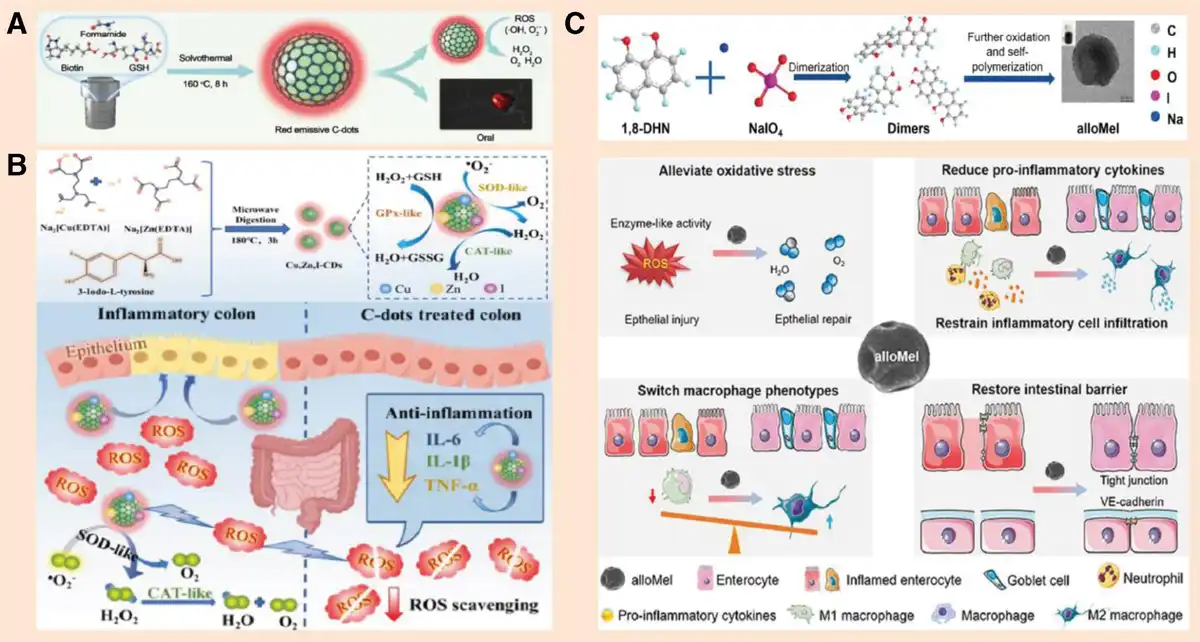
Figure 6.
Application of nonmetal-based nanozymes in GI. (A) Synthesis of C-dots nanozymes[152]. Copyright 2024, Elsevier. (B) Schematic illustration of the synthesis and therapy application of Cu, Zn, I-CD nanozyme for mice with colitis[154]. Copyright 2024, American Chemical Society. (C) Synthesis and schematic illustration of the therapeutic mechanisms of oral alloMel against colitis[163]. Copyright 2024, Elsevier.
In the field of H pylori infection treatment, pH-responsive fullerene alcohol nanoparticles (FNPs) have achieved breakthrough progress[157]. FNPs achieve precise antibacterial effects through molecular structural transformations triggered by gastric acid. In an acidic environment, the hydroxyl groups of FNPs rearrange to form active carbonyl groups (C=O), significantly enhancing their POD activity, with catalytic efficiency positively correlated with C=O content. These nanoparticles can specifically destroy the cell walls and biofilms of H pylori, and are equally effective against drug-resistant strains. Experimental evidence shows that they function through a reversible substrate binding-catalytic cycle, offering advantages such as high selectivity and no development of drug resistance, thereby providing an innovative nonantibiotic solution for H pylori treatment.
Metal-doped carbon-based nanozymes have demonstrated breakthrough progress in the treatment of GI through multienzyme synergistic action and intelligent response design. Iron/nitrogen codoped hollow porous carbon nanospheres (Fe/N-HCNs) exhibit 4 enzyme-mimicking activities: POD, OXD, CAT, and SOD. These not only effectively scavenge ROS but also regulate the inflammatory microenvironment through enzymatic reactions, demonstrating significant therapeutic effects in bacterial infection and DSS-induced colitis models[156]. Similarly, platinum-doped carbon nanodots achieve efficient ROS scavenging by mimicking the SOD/CAT cascade reaction. When coloaded with spleen tyrosine kinase inhibitors in platelet membrane-coated nanoparticles, they can precisely target inflammatory sites, inhibit neutrophil infiltration, and promote epithelial repair, thereby reversing intestinal barrier dysfunction[160]. To further optimize the stability and catalytic efficiency of nanozymes, researchers developed iodine-copper-zinc covalently doped carbon dots (Cu, Zn, I-CDs), where iodine doping effectively neutralizes the positive charge of metal ions in acidic environments, enabling them to maintain excellent triple antioxidant activity (CAT, SOD, and GPx) even under low pH conditions. In vitro experiments confirmed that this material not only alleviates cellular oxidative damage but also downregulates the expression of proinflammatory factors such as TNF-α and IL-1β. In a DSS-induced colitis model, it significantly improves pathological features such as colon shortening and mucosal damage (Figure 6B)[154]. For H pylori infection, pH-responsive nanozymes (such as PtCo@G) achieve selective bactericidal activity in the gastric acid environment through surface modification with phenylboronic acid. Their catalytic activity is activated only under acidic conditions, thereby avoiding unintended damage to the intestinal microbiota[158]. Additionally, dual-targeted nanozymes (PtCo@G@H2A) enhance targeting efficiency by 850% through a dual mechanism of heme receptor binding and pH-dependent charge reversal (L-arginine protonation). They also generate selective ROS via cascade catalytic reactions, maintaining high bactericidal efficacy in gastric acid and pepsin environments while avoiding intestinal side effects through surface potential regulation[159].
4.2.2 Melanin nanozymes for GI
Metal-free melanin nanomaterials can also be effective in the treatment of GI, as summarized in Table 5. Melanin-based nanomaterials (MeNPs) utilize their unique phenol/quinone redox structure to efficiently scavenge ROS, demonstrating multitarget regulatory capabilities in IBD treatment. They can simultaneously alleviate 6 major pathological features: oxidative stress, endoplasmic reticulum stress, cell apoptosis, inflammatory response, intestinal epithelial damage, and gut microbiota dysbiosis[161]. To further enhance targeting and therapeutic efficacy, researchers developed a probiotic-nanocatalyst composite system (Lf@MPB) by modifying melanin nanoparticles onto the surface of Lactobacillus fermentum. This not only enhances the survival rate of probiotics in the gastrointestinal environment but also achieves precise accumulation at inflammatory sites. Experiments confirmed that this system significantly reduces mitochondrial membrane potential, inhibits cell apoptosis, and exerts synergistic therapeutic effects by regulating the composition of the intestinal microbiota[162]. Additionally, allomelanin-like nanodrugs (alloMel) demonstrate superior performance, with antioxidant capacity 2.5-fold that of conventional drugs such as 5-aminosalicylic acid. They specifically target colitis lesions by inhibiting the TLR4/MyD88/NF-κB signaling pathway, effectively regulating macrophage polarization, reducing inflammatory cell infiltration, and restoring intestinal barrier integrity (Figure 6C)[163]. These melanin-based nanocatalysts offer a novel metal-free nanocatalytic therapeutic strategy for GI diseases.
Table 5
List of melanin nanozymes and other nonmetal nanozymes, their enzyme mimetic activity, and efficacy study in GI.
| Nanozyme | Abbreviation for nanozymes | Enzyme-like activities | Test models | Schematic illustration of nanozyme for GI therapy | Preparation method | References |
|---|---|---|---|---|---|---|
| Metal-free melanin nanozymes | MeNPs | SOD | DSS-induced colitis model | MeNPs can alleviate 6 major pathological features of IBD, including oxidative stress, endoplasmic reticulum stress, apoptosis, inflammation, intestinal epithelial damage, and intestinal flora disruption, and have a favorable therapeutic effect on IBD. | Stöber-like method | [161] |
| With Lactobacillus fermentum (Lf) as the core and modified melanin nanoparticles (MNPs) on its surface | Lf@MPB | SOD, CAT, GPx | DSS-induced UC model | Lf@MPB reduces cellular mitochondrial polarization, inhibits apoptosis and also significantly increases the viability of Lf probiotics. It also alleviated oxidative stress and inflammatory responses, increased the abundance and diversity of gut microbial communities, and restored the intestinal barrier. | O-diol borate-based click reaction | [162] |
| Allomelanin-like nanomedicine | alloMel | SOD, GPx | DSS-induced acute colitis model | The self-perpetuating proinflammatory microenvironment was improved by a combination of attenuating oxidative stress, reducing proinflammatory cytokine production, inhibiting inflammatory cell infiltration, switching macrophage phenotype, and restoring intestinal barrier integrity. | Solution Stirring Method | [163] |
| Single-atom catalyst-armed BL probiotics | BL@B-SA50 | SOD, CAT | DSS-induced IBD model | The system continuously removes elevated ROS, relieves inflammatory factors, improves bacterial viability, remodels the intestinal barrier and restores the intestinal microbiota. | Solution Stirring Method | [164] |
| Lipid-polymer hybrid nanoparticles with folate surface functionalization | SNP-FA | SOD | TNBS-induced colitis mice | SNP-FA shows excellent mucus permeability and inflammation targeting properties, and can regulate the secretion of inflammation-related cytokines to effectively alleviate the inflammatory response. | Solution Method | [165] |
| DNase-I nanozyme | DNase-NZ | Multi-antioxidant enzyme-like activity | DSS-induced colitis model | DNase-NZ may improve various pathophysiological features of IBD by attenuating colonic neutrophil infiltration and NETosis. | Surface coating method | [166] |
| Platinum-doped carbon nanodot nanozymes (PtCD) and piceatannol were coloaded in PLGA and coated with platelet membrane | PM@Pic/PtCD@NP | SOD, CAT | DSS-induced colitis model | Nanozymes scavenge ROS, reduce the expression of proinflammatory factors, decrease neutrophil infiltration and restore the function of the intestinal barrier. | Microemulsion method | [160] |
| Bifidobacterium longum (BL) was loaded and integrated with hyaluronic acid-bilirubin nanomedicine (HABN) | BL@HABN | SOD | DSS-induced acute colitis model | BL@HABN protect colonic epithelial cells from ROS-mediated cytotoxicity. It also reduced proinflammatory cytokine production, induced type 2 macrophage (M2) differentiation and promoted epithelial barrier repair. Importantly, it also restored the abundance and diversity of the gut microbiota. | Aggregation method | [167] |
| A hyperthermostable SOD from the Thermus thermophilus HB27 | TtSOD | SOD | 2,4,6-trinitrobenzenesulfonic acid-induced IBD zebrafish; DSS-induced colitis model | TtSOD treatment reduces intestinal enlargement, attenuates neutrophil infiltration, relieves enteritis, and protects intestinal barrier function. | Expressed and purified from Escherichia coli | [168] |
| Integrated Escherichia coli Nissle 1917 membrane (EM) with CurFe nanozyme | CF@EM | SOD | DSS-induced colitis model | CF@EM demonstrates a strong ability to colonize the inflamed colon and restore intestinal redox balance and barrier function. CF@EM influences the gut microbiome towards a beneficial state by enhancing bacterial diversity and shifting the compositional structure toward an anti-inflammatory phenotype. | Ultrasound mixing | [169] |
| Single-atom Ptimmobilized Nb2CTx nanosheet | SA Pt-Nb2CTx | GPx, SOD | Hunan mice of ethanol-induced gastric mucosal injury | Nanozyme can both achieve highly sensitive Fe2+ detection (detection limit 1.02 μM) and effectively treat ethanol-induced gastric mucosal damage through its antioxidant and anti-inflammatory effects. | Solution Stirring Method | [170] |
DSS, Dextran Sulfate Sodium.
4.3 Other nanozymes for GI
The emergence of single-atom nanozymes (SAzymes) as a new generation of biomimetic catalysts has demonstrated unique advantages in the treatment of gastrointestinal inflammation. Their atomically dispersed active metal centers effectively mimic the body’s natural antioxidant defense system. The BL@B-SA50 system is constructed using Bifidobacterium longum as a carrier, enabling targeted delivery of probiotics for sustained ROS scavenging and effective inhibition of inflammatory factors[164]. In UC and CD models, it not only significantly restores intestinal barrier function but also optimizes the composition of the microbiota. Its clinical translation potential has been validated in beagle dog experiments. In the prevention and treatment of gastric mucosal damage, the SA Pt-Nb2CTx nanozyme developed using a niobium vacancy-defect MXene carrier exhibits dual GPx and SOD-like activity. It can detect Fe2+ at 1.02 μM levels via fluorescence sensing for early diagnosis and effectively prevent ethanol-induced gastric mucosal damage through antioxidant and anti-inflammatory mechanisms (Figure 7A)[170]. These breakthroughs demonstrate that SAzymes, through an integrated “diagnosis-treatment” design, can overcome the challenges of traditional probiotic colonization and address therapeutic challenges in complex gastric pathological environments, providing innovative solutions for precise intervention in GI.
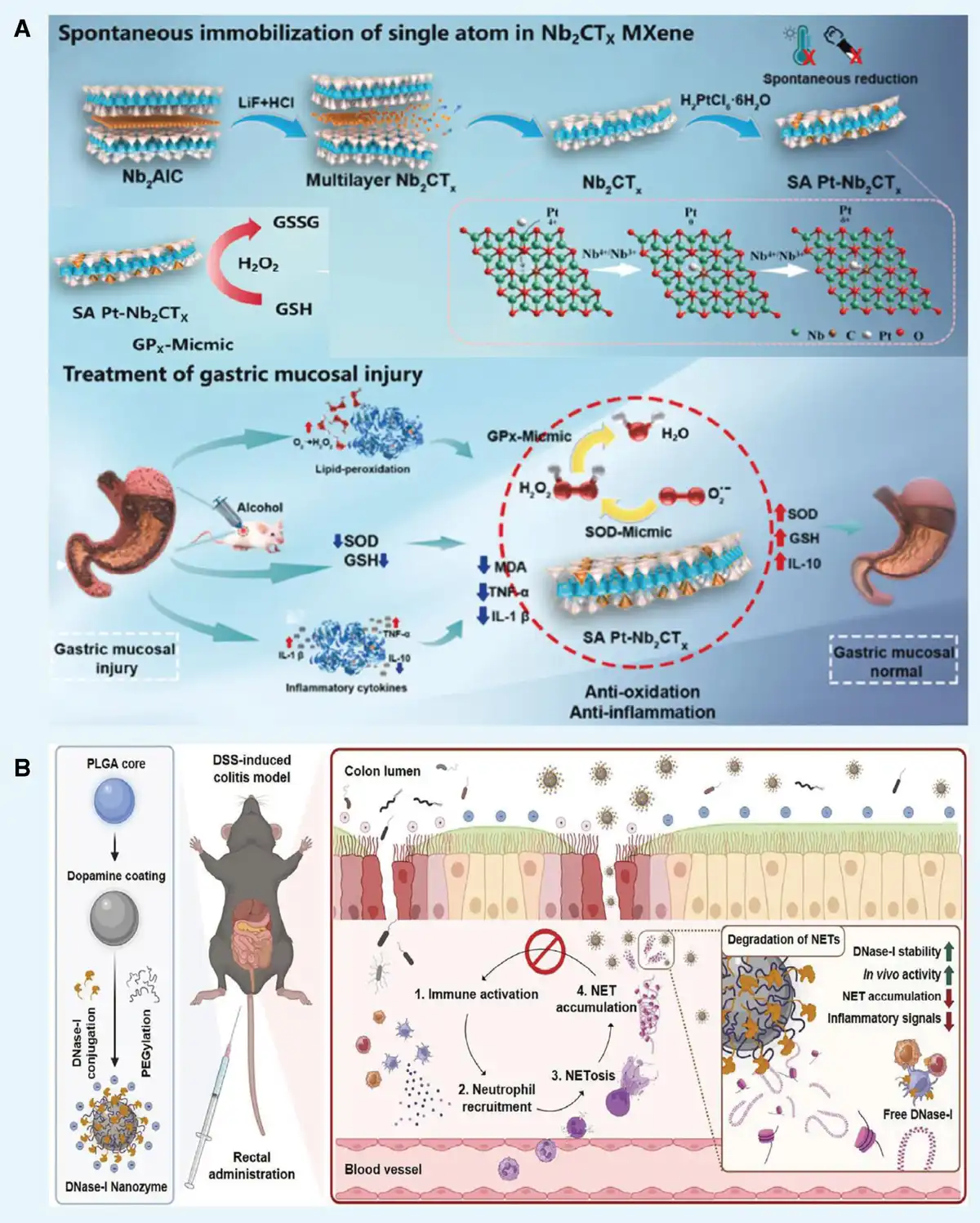
Figure 7.
Application of other nanozymes in GI. (A) Schematic diagram of the formation of SA Pt-Nb2CTx nanozyme and prevention of alcohol-induced gastric mucosal damage[170]. Copyright 2025, Biosensors and Bioelectronics. (B) Schematic illustration of the fabrication of DNase-NZ and their application in the treatment of colitis[166]. Copyright 2024, Springer.
The key role of gut microbiota dysbiosis in the pathogenesis of IBD has been confirmed, and innovative treatment strategies based on nanozymes are breaking through the limitations of traditional probiotic therapies in terms of targeting and colonization efficiency. Recent studies have developed various biomimetic nanozyme systems. Inspired by Escherichia coli Nissle 1917, the copper-iron nanozyme (CF@EM) leverages the inflammatory targeting properties of probiotic membranes to significantly enhance nanozyme accumulation and retention at the lesion site, effectively restoring intestinal barrier function and regulating microbial composition toward an anti-inflammatory phenotype[169]. A PB nanozyme system (PB@N3/LR@DBCO) based on click chemistry achieves precise spatiotemporal colonization of Lactobacillus reuteri. Its specific “click” reaction maintains efficient ROS clearance and microbiota regulation functions even in complex inflammatory environments[142]. The overproduction and accumulation of neutrophil extracellular traps (NETs), also known as NETosis, have been identified to exacerbate the inflammatory response and induce further tissue damage in IBD. This finding has prompted many researchers to investigate NETs as a potential therapeutic target. DNase-I is a natural agent that effectively disrupts NETs, which are immobilized on the surface of polymeric nanoparticles to maintain their enzymatic properties while prolonging their activity in the colon. Delivery of DNase-I using nanozymes enhances stability and prolongs DNase-I activity with minimal toxicity. More importantly, administration of DNase-I nanozymes successfully attenuated colonic neutrophil infiltration and NETosis compared with free DNase-I (Figure 7B)[166]. These innovative strategies, by synergistically regulating the "oxidative stress-microbiome-immune microenvironment" network, not only overcome the limitations of traditional probiotics but also establish a new paradigm for multitargeted intervention in IBD treatment.
The above research examples show that nanozymes, with their unique catalytic activity and multifunctionality, provide a new intervention strategy for GI treatment.
4.4 Systematic comparison of various nanozyme platforms
Although various types of nanozymes demonstrate potential in treating GI, their material nature determines distinct characteristics in catalytic performance, biosafety, and therapeutic focus. This section systematically compares nanozyme platforms (Table 6) to provide a decision-making framework for precision design toward clinical translation. In this comparative analysis, distinct characteristic profiles emerge across nanozyme categories: Metal- and metal oxide-based nanozymes (eg, CeO2 and Fe3O4) maintain high catalytic activity while exhibiting excellent antioxidant enzyme diversity (eg, SOD/CAT cascade) and biocompatibility. MOF-based nanozymes achieve ultimate enzymatic diversity and functional integration through programmable pore structures and metal nodes, making them ideal platforms for smart delivery and synergistic therapy. Carbon-based nanozymes demonstrate stable and flexible performance in catalytic kinetic therapy. Melanin-based nanozymes stand out in bioprotection due to their exceptional biocompatibility and broad-spectrum ROS-scavenging capabilities. SAzymes achieve peak catalytic efficiency through atomically dispersed active sites, though their enzymatic activity remains relatively limited. Overall, each material platform offers distinct advantages—from catalytic efficiency and biosafety to design flexibility-collectively forming a functionally complementary nanozyme therapeutic toolkit. This provides diversified solutions for precisely addressing the complex pathological environment of GI.
Table 6
Systematic comparative analysis of various nanozyme platforms.
| Dimension | Metal-based | Metal oxide-based | MOF-based | Carbon-based | Melanin-based |
|---|---|---|---|---|---|
| Catalytic efficiency | High, especially noble metals (POD-like) | Moderate to High, depends on valence state and oxygen vacancies | Tunable to High, depends on metal nodes and pore environment | Moderate, conductivity aids electron transfer | Relatively Low, broad-spectrum scavenging rather than efficient catalysis |
| Enzyme diversity | Relatively Single, mainly POD, some OXD | Good, especially CeO2 (SOD/CAT cascade) | Excellent, programmable (OXD, POD, CAT, etc) | Relatively Single, mainly POD, some OXD | Relatively Single, superior ROS scavenging but few catalytic activities |
| Biocompatibility | Moderate, noble metals inert but persistent | Good, Fe, Ce, Mn are essential elements | Variable, Zn/Fe-based good; others (eg, Co) need caution | Good, potential long-term retention concerns | Excellent, inherent biocompatibility and biodegradability |
| Physiological stability | High, chemically stable | High, structurally stable | Moderate, may degrade in acidic/complex milieus | High, chemically stable | Moderate, biodegradable, stable within therapeutic window |
| Therapeutic focus | CDT, using POD activity to kill pathogens/cells | Antioxidant/anti-inflammatory (CeO2), CDT (Fe3O4) | Combo Therapy/Smart Delivery, ideal for integrating therapies | CDT, Biosensing and Detection | Antioxidant/Bioprotection, Photothermal Therapy (PTT), Immunomodulation |
| Design flexibility | Moderate, size, morphology, alloying | Moderate, morphology, doping, surface modification | Extremely High, precise control over composition, structure, pores, surface | Moderate, heteroatom doping, surface functionalization | Moderate, rich surface groups for functionalization |
CDT, Catalytic dynamic therapy; OXD, Oxidase.
5. Conclusion and Outlook
Nanozymes, as an emerging biomimetic catalytic material, demonstrate tremendous application potential in the treatment of GI. By mimicking the activities of multiple natural enzymes such as SOD, CAT, GPx, and OXD, nanozymes can precisely intervene in the core pathological processes of GI: effectively eliminating excess reactive oxygen and nitrogen species, reprogramming dysregulated immune responses, repairing damaged intestinal barriers, and restoring imbalanced gut microbiota. This pathologically targeted, synergistic intervention strategy transcends the single-action mode of traditional drugs, offering novel insights and solutions for treating IBDs. Diverse nanozyme material platforms—ranging from classic metal/metal oxides to structurally tunable MOFs and biocompatible melanin—collectively form a functionally rich therapeutic toolkit, providing versatile options for addressing different treatment scenarios and needs. Despite significant progress in nanozyme development, research in GI treatment remains in its early stages, with numerous critical issues and challenges awaiting resolution.
The development of high-performance nanozymes currently faces the core challenge of enhancing catalytic efficiency. While regulating the valence state of the active site can effectively modulate catalytic activity, there is an urgent need to introduce AI-assisted design (such as machine learning for predicting active sites and molecular docking for optimizing targeting) to accelerate the R&D process. Future nanozymes will transcend simple catalytic materials to become intelligent systems capable of sensing and responding to pathological microenvironments[171]. Through rational design of chemical bonds or structures responsive to specific stimuli (eg, pH, H2O2 concentration, and specific enzymes)[172], nanozymes can achieve precise activation and on-demand release of activity at the lesion site, thereby maximizing therapeutic efficacy while minimizing off-target toxicity. At the mechanism level, the catalytic mechanisms of nanozymes in vivo and vitro remain unclear. Advanced computational simulations (eg, DFT), machine learning, and high-throughput screening technologies will deeply elucidate the structure-activity relationships of nanozymes at the atomic/molecular level[106]. Clarifying the intrinsic connections between the electronic structure and coordination environment of active sites and their catalytic performance will provide a solid theoretical foundation for guiding the targeted design and optimization of high-performance nanozymes. Of course, rational design must fully consider clinical needs. This includes developing fully biodegradable nanozymes to address long-term safety concerns, investigating their in vivo metabolic pathways and fate, and optimizing targeting and pharmacokinetic properties through rational surface engineering. Rationally designed nanozymes hold promise to overcome existing therapeutic bottlenecks and usher in a new era of precision treatment for GI.
Acknowledgements
This work was financially supported by the National Natural Science Foundation of China (Grant Nos. 82304442, 22304099, and 82574366), Chinese Academy of Medical Sciences Innovation Fund for Medical Sciences (Grant Nos. 2024-I2M-3-013 and 2023-I2M-2-001), the National Key R&D Program of China (Grant Nos. 2023YFC3504401 and 2022YFA1103403), Beijing Natural Science Foundation (L256002), Beijing Out-standing Young Scientist Program (Grant No. JWZQ20240101019), China Postdoctoral Science Foundation Funded Project (Grant Nos. 2023T160372, 2022M713402, 2022M711779, and BX20220160), and the National Key R&D Program of China under the 14th Five-Year Plan (Grant No. 2024YFD1301304).
Conflicts of interests
The authors declare that they have no conflicts of interest.
Author contributions
Yanjin Du: investigation, formal analysis, writing original draft; Zude He, Fengyu Guo and Chong Chen: methodology, validation, funding acquisition, project administration; Fazheng Ren and Pengjie Wang: conceptualization, funding acquisition; Yongjian Ai and Ping Liu: conceptualization, funding acquisition, project administration, writing review and editing. All authors have read and agreed to the published version of the manuscript.
References
- [1] Gao L, Zhuang J, Nie L, et al. Intrinsic peroxidase-like activity of ferromagnetic nanoparticles. Nat Nanotechnol. 2007;2(9):577–583.
- [2] Liu X, Xu H, Peng H, et al. Advances in antioxidant nanozymes for biomedical applications. Coord Chem Rev. 2024;502:215610.
- [3] Wang Q, Jiang J, Gao L. Nanozyme-based medicine for enzymatic therapy: progress and challenges. Biomed Mater. 2021;16(4):042002.
- [4] Ai Y, Hu ZN, Liang X, et al. Recent advances in nanozymes: from matters to bioapplications. Adv Funct Mater. 2022;32(14):2110432.
- [5] Zhang DD, Wang PY. Intestinal stem cells (ISCs): ISCs-derived organoids for disease modeling and therapy. Eur Cell Mater. 2025;50:84–86.
- [6] Jian X-L, Zeng P-H, Li K-X, et al. FGF2 promotes the chemotherapy resistance in colon cancer cells through activating PI3K/Akt signaling pathway. Oncol Transl Med. 2023;9(6):281–286.
- [7] Kaser A, Zeissig S, Blumberg RS. Genes and environment: how will our concepts on the pathophysiology of IBD develop in the future? Dig Dis. 2010;28(3):395–405.
- [8] Pop R, Tăbăran A-F, Ungur AP, et al. Helicobacter Pylori-induced gastric infections: from pathogenesis to novel therapeutic approaches using silver nanoparticles. Pharmaceutics. 2022;14(7):1463.
- [9] Tian T, Wang Z, Zhang J. Pathomechanisms of oxidative stress in inflammatory bowel disease and potential antioxidant therapies. Oxid Med Cell Longev. 2017;2017(1):4535194.
- [10] Cardos IA, Zaha DC, Sindhu RK, et al. Revisiting therapeutic strategies for H. pylori treatment in the context of antibiotic resistance: focus on alternative and complementary therapies. Molecules. 2021;26(19):6078.
- [11] Xie Y, Hu F, Xiang D, et al. The metabolic effect of gut microbiota on drugs. Drug Metab Rev. 2020;52(1):139–156.
- [12] Nathan C, Cunningham-Bussel A. Beyond oxidative stress: an immunologist’s guide to reactive oxygen species. Nat Rev Immunol. 2013;13(5):349–361.
- [13] Zhang Y-Z, Li Y-Y. Inflammatory bowel disease: pathogenesis. World J Gastroenterol. 2014;20(1):91–99.
- [14] Liu HW, Yuan SG, Zheng K, et al. Mechanical load rescues injury-induced skeletal muscle fibrosis through macrophage polarization. Eur Cell Mater. 2024;48:137–150.
- [15] Wallace KL, Zheng L-B, Kanazawa Y, et al. Immunopathology of inflammatory bowel disease. World J Gastroenterol. 2014;20(1):6–21.
- [16] Oshima T, Miwa H. Gastrointestinal mucosal barrier function and diseases. J Gastroenterol. 2016;51(8):768–778.
- [17] Guan Q. A comprehensive review and update on the pathogenesis of inflammatory bowel disease. J Immunol Res. 2019;2019(1):7247238.
- [18] Nell S, Suerbaum S, Josenhans C. The impact of the microbiota on the pathogenesis of IBD: lessons from mouse infection models. Nat Rev Microbiol. 2010;8(8):564–577.
- [19] Medzhitov R. Recognition of microorganisms and activation of the immune response. Nature. 2007;449(7164):819–826.
- [20] Thao NTM, Do HDK, Nam NN, et al. Antioxidant nanozymes: mechanisms, activity manipulation, and applications. Micromachines. 2023;14(5):1017.
- [21] McCord JM, Fridovich I. Superoxide dismutase: an enzymic function for erythrocuprein (hemocuprein). J Biol Chem. 1969;244(22):6049–6055.
- [22] Liu M, Sun X, Chen B, et al. Insights into manganese superoxide dismutase and human diseases. Int J Mol Sci. 2022;23(24):15893.
- [23] Fukai T, Ushio-Fukai M. Superoxide dismutases: role in redox signaling, vascular function, and diseases. Antioxid Redox Signal. 2011;15(6):1583–1606.
- [24] Bielski BH, Cabelli DE, Arudi RL, et al. Reactivity of HO2/O−2 radicals in aqueous solution. J Phys Chem Ref Data. 1985;14(4):1041–1100.
- [25] Tian R, Xu J, Luo Q, et al. Rational design and biological application of antioxidant nanozymes. Front Chem. 2021;8:831.
- [26] Gao W, He J, Chen L, et al. Deciphering the catalytic mechanism of superoxide dismutase activity of carbon dot nanozyme. Nat Commun. 2023;14(1):160.
- [27] Tonial CH, Rodrigues MF, Bosse MA, et al. Technical and economic evaluation of cultivation and obtaining of varronia curassavica Jacq. Essential oil. Ind Crops Prod. 2020;154:112650.
- [28] Alfonso-Prieto M, Biarnés X, Vidossich P, et al. The molecular mechanism of the catalase reaction. J Am Chem Soc. 2009;131(33):11751–11761.
- [29] Liu Q, Zhang A, Wang R, et al. A review on metal-and metal oxide-based nanozymes: properties, mechanisms, and applications. Nano Micro Lett. 2021;13:1–53.
- [30] Xu D, Wu L, Yao H, et al. Catalase-like nanozymes: classification, catalytic mechanisms, and their applications. Small. 2022;18(37):2203400.
- [31] Pirmohamed T, Dowding JM, Singh S, et al. Nanoceria exhibit redox state-dependent catalase mimetic activity. Chem Commun (Camb). 2010;46(16):2736–2738.
- [32] Celardo I, Pedersen JZ, Traversa E, et al. Pharmacological potential of cerium oxide nanoparticles. Nanoscale. 2011;3(4):1411–1420.
- [33] Li J, Liu W, Wu X, et al. Mechanism of pH-switchable peroxidase and catalase-like activities of gold, silver, platinum and palladium. Biomaterials. 2015;48:37–44.
- [34] Fan J, Yin J-J, Ning B, et al. Direct evidence for catalase and peroxidase activities of ferritin–platinum nanoparticles. Biomaterials. 2011;32(6):1611–1618.
- [35] Wang C, Li Y, Yang W, et al. Nanozyme with robust catalase activity by multiple mechanisms and its application for hypoxic tumor treatment. Adv Healthcare Mater. 2021;10(19):2100601.
- [36] Kendall A, Woolcock A, Brooks A, et al. Glutathione peroxidase activity, plasma total antioxidant capacity, and urinary F2‐isoprostanes as markers of oxidative stress in anemic dogs. J Vet Intern Med. 2017;31(6):1700–1707.
- [37] Lubos E, Loscalzo J, Handy DE. Glutathione peroxidase-1 in health and disease: from molecular mechanisms to therapeutic opportunities. Antioxid Redox Signaling. 2011;15:1957–1997.
- [38] Carsol MA, Pouliquen‐Sonaglia I, Lesgards G, et al. A new kinetic model for the mode of action of soluble and membrane‐immobilized glutathione peroxidase from bovine erythrocytes—effects of selenium. Eur J Biochem. 1997;247(1):248–255.
- [39] Flohé L, Loschen G, Günzler WA, et al. Glutathione peroxidase, V. The kinetic mechanism. Hoppe Seylers Z Physiol Chem. 1972;353(6):987–999.
- [40] Zhang D, Shen N, Zhang J, et al. A novel nanozyme based on selenopeptide-modified gold nanoparticles with a tunable glutathione peroxidase activity. RSC Adv. 2020;10(15):8685–8691.
- [41] Huang Y, Liu C, Pu F, et al. A GO–Se nanocomposite as an antioxidant nanozyme for cytoprotection. Chem Commun. 2017;53(21):3082–3085.
- [42] Liu Q, Zhang A, Wang R, et al. A review on metal-and metal oxide-based nanozymes: properties, mechanisms, and applications. Nano-Micro Lett. 2021;13(1):154.
- [43] Cheng H, Lin S, Muhammad F, et al. Rationally modulate the oxidase-like activity of nanoceria for self-regulated bioassays. ACS Sens. 2016;1(11):1336–1343.
- [44] Zhang X, Huang Y. Evaluation of the antioxidant activity of phenols and tannic acid determination with Mn3O4 nano-octahedrons as an oxidase mimic. Anal Methods. 2015;7(20):8640–8646.
- [45] Sozarukova MM, Proskurnina EV, Popov AL, et al. New facets of nanozyme activity of ceria: lipo-and phospholipoperoxidase-like behaviour of CeO2 nanoparticles. RSC Adv. 2021;11(56):35351–35360.
- [46] Cao C, Yang N, Su Y, et al. Starvation, ferroptosis, and prodrug therapy synergistically enabled by a cytochrome c oxidase like nanozyme. Adv Mater. 2022;34(29):2203236.
- [47] Chen M, Wang Z, Shu J, et al. Mimicking a natural enzyme system: cytochrome c oxidase-like activity of Cu2O nanoparticles by receiving electrons from cytochrome c. Inorg Chem. 2017;56(16):9400–9403.
- [48] Liu Y, Wu H, Chong Y, et al. Platinum nanoparticles: efficient and stable catechol oxidase mimetics. ACS Appl Mater Interfaces. 2015;7(35):19709–19717.
- [49] Liu J, Jiang X, Wang L, et al. Ferroxidase-like activity of Au nanorod/Pt nanodot structures and implications for cellular oxidative stress. Nano Res. 2015;8(12):4024–4037.
- [50] Kisailus D, Najarian M, Weaver JC, et al. Functionalized gold nanoparticles mimic catalytic activity of a polysiloxane‐synthesizing enzyme. Adv Mater. 2005;17(10):1234–1239.
- [51] Kuchma MH, Komanski CB, Colon J, et al. Phosphate ester hydrolysis of biologically relevant molecules by cerium oxide nanoparticles. Nanomed Nanotechnol Biol Med. 2010;6(6):738–744.
- [52] Chen D, Jiang L, Lei T, et al. Magnetic CuFe2O4 with intrinsic protease-like activity inhibited cancer cell proliferation and migration through mediating intracellular proteins. Biomater Biosyst. 2022;5:100038.
- [53] Sun M, Xu L, Qu A, et al. Site-selective photoinduced cleavage and profiling of DNA by chiral semiconductor nanoparticles. Nat Chem. 2018;10(8):821–830.
- [54] Li F, Li S, Guo X, et al. Chiral carbon dots mimicking topoisomerase I to mediate the topological rearrangement of supercoiled DNA enantioselectively. Angew Chem Int Ed Engl. 2020;59(27):11087–11092.
- [55] Wang F, Zhang Y, Liu Z, et al. A biocompatible heterogeneous MOF–Cu catalyst for in vivo drug synthesis in targeted subcellular organelles. Angew Chem Int Ed Engl. 2019;58(21):6987–6992.
- [56] Tao G, Liu F, Jin Z, et al. A strategy of local hydrogen capture and catalytic hydrogenation for enhanced therapy of chronic liver diseases. Theranostics. 2023;13(8):2455–2470.
- [57] Hu S, Zhao R, Xu Y, et al. Orally-administered nanomedicine systems targeting colon inflammation for the treatment of inflammatory bowel disease: latest advances. J Mater Chem B. 2024;12(1):13–38.
- [58] Hossen I, Hua W, Ting L, et al. Phytochemicals and inflammatory bowel disease: a review. Crit Rev Food Sci Nutr. 2022;60(8):1321–1345.
- [59] Baldim V, Bedioui F, Mignet N, et al. The enzyme-like catalytic activity of cerium oxide nanoparticles and its dependency on Ce3+ surface area concentration. Nanoscale. 2018;10(15):6971–6980.
- [60] Dutta P, Pal S, Seehra M, et al. Concentration of Ce3+ and oxygen vacancies in cerium oxide nanoparticles. Chem Mater. 2006;18(21):5144–5146.
- [61] Shlapa Y, Solopan S, Sarnatskaya V, et al. Cerium dioxide nanoparticles synthesized via precipitation at constant pH: synthesis, physical-chemical and antioxidant properties. Colloids Surf B Biointerfaces. 2022;220:112960.
- [62] Xia F, Hu X, Zhang B, et al. Ultrasmall ruthenium nanoparticles with boosted antioxidant activity upregulate regulatory T cells for highly efficient liver injury therapy. Small. 2022;18(29):2201558.
- [63] An M, He M-Q, Lin C, et al. Recent progress of nanozymes with different spatial dimensions for bioanalysis. Mater Today Nano. 2023;22:100330.
- [64] Singh N, Geethika M, Eswarappa SM, et al. Manganese‐based nanozymes: multienzyme redox activity and effect on the nitric oxide produced by endothelial nitric oxide synthase. Chem Eur J. 2018;24(33):8393–8403.
- [65] Ghosh S, Roy P, Karmodak N, et al. Nanoisozymes: crystal‐facet‐dependent enzyme‐mimetic activity of V2O5 nanomaterials. Angew Chem. 2018;130(17):4600–4605.
- [66] Ge C, Fang G, Shen X, et al. Facet energy versus enzyme-like activities: the unexpected protection of palladium nanocrystals against oxidative damage. ACS Nano. 2016;10(11):10436–10445.
- [67] Mu J, Zhang L, Zhao M, et al. Catalase mimic property of Co3O4 nanomaterials with different morphology and its application as a calcium sensor. ACS Appl Mater Interfaces. 2014;6(10):7090–7098.
- [68] Zhou S, Cai H, He X, et al. Enzyme-mimetic antioxidant nanomaterials for ROS scavenging: design, classification, and biological applications. Coord Chem Rev. 2024;500:215536.
- [69] Gupta A, Das S, Neal CJ, et al. Controlling the surface chemistry of cerium oxide nanoparticles for biological applications. J Mater Chem B. 2016;4(19):3195–3202.
- [70] Zhang S, Liu Y, Sun S, et al. Catalytic patch with redox Cr/CeO2 nanozyme of noninvasive intervention for brain trauma. Theranostics. 2021;11(6):2806–2821.
- [71] Sun L, Li W, Liu Z, et al. Iodine-doped single-atom cobalt catalysts with boosted antioxidant enzyme-like activity for colitis therapy. Chem Eng J. 2023;453:139870.
- [72] Wang C, Qian J, Wang K, et al. Colorimetric aptasensing of ochratoxin A using Au@Fe3O4 nanoparticles as signal indicator and magnetic separator. Biosens Bioelectron. 2016;77:1183–1191.
- [73] Jiang D, Ni D, Rosenkrans ZT, et al. Nanozyme: new horizons for responsive biomedical applications. Chem Soc Rev. 2019;48(14):3683–3704.
- [74] Bhagat S, Vallabani NS, Shutthanandan V, et al. Gold core/ceria shell-based redox active nanozyme mimicking the biological multienzyme complex phenomenon. J Colloid Interface Sci. 2018;513:831–842.
- [75] Huo J, Hao J, Mu J, et al. Surface modification of Co3O4 nanoplates as efficient peroxidase nanozymes for biosensing application. ACS Appl Bio Mater. 2021;4(4):3443–3452.
- [76] Deshwal A, Saxena K, Sharma G, et al. Nanozymes: a comprehensive review on emerging applications in cancer diagnosis and therapeutics. Int J Biol Macromol. 2024;256:128272.
- [77] Yang J, Zhang R, Zhao H, et al. Bioinspired copper single‐atom nanozyme as a superoxide dismutase‐like antioxidant for sepsis treatment. Exploration. 2022;2(4):20210267.
- [78] Liu CP, Wu TH, Lin YL, et al. Tailoring enzyme‐like activities of gold nanoclusters by polymeric tertiary amines for protecting neurons against oxidative stress. Small. 2016;12(30):4127–4135.
- [79] Yang S, Ji J, Luo M, et al. Poly (tannic acid) nanocoating based surface modification for construction of multifunctional composite CeO2 NZs to enhance cell proliferation and antioxidative viability of preosteoblasts. Nanoscale. 2021;13(38):16349–16361.
- [80] Liu X, Wei W, Yuan Q, et al. Apoferritin–CeO2 nano-truffle that has excellent artificial redox enzyme activity. Chem Commun. 2012;48(26):3155–3157.
- [81] Su L, Qin S, Xie Z, et al. Multi-enzyme activity nanozymes for biosensing and disease treatment. Coord Chem Rev. 2022;473:214784.
- [82] Yang W, Yang X, Zhu L, et al. Nanozymes: activity origin, catalytic mechanism, and biological application. Coord Chem Rev. 2021;448:214170.
- [83] Liu Y, Wu H, Li M, et al. pH dependent catalytic activities of platinum nanoparticles with respect to the decomposition of hydrogen peroxide and scavenging of superoxide and singlet oxygen. Nanoscale. 2014;6(20):11904–11910.
- [84] He W, Zhou Y-T, Wamer WG, et al. Mechanisms of the pH dependent generation of hydroxyl radicals and oxygen induced by Ag nanoparticles. Biomaterials. 2012;33(30):7547–7555.
- [85] He W, Zhou Y-T, Wamer WG, et al. Intrinsic catalytic activity of Au nanoparticles with respect to hydrogen peroxide decomposition and superoxide scavenging. Biomaterials. 2013;34(3):765–773.
- [86] Chen Z, Yin J-J, Zhou Y-T, et al. Dual enzyme-like activities of iron oxide nanoparticles and their implication for diminishing cytotoxicity. ACS Nano. 2012;6(5):4001–4012.
- [87] Wu T, Ma Z, Li P, et al. Bifunctional colorimetric biosensors via regulation of the dual nanoenzyme activity of carbonized FeCo-ZIF. Sens Actuators B. 2019;290:357–363.
- [88] Xu C, Bing W, Wang F, et al. Versatile dual photoresponsive system for precise control of chemical reactions. ACS Nano. 2017;11(8):7770–7780.
- [89] Tripathi RM, Chung SJ. Eco-friendly synthesis of SnO2-Cu nanocomposites and evaluation of their peroxidase mimetic activity. Nanomaterials (Basel). 2021;11(7):1798.
- [90] Zhang Q, Chen S, Wang H. A surface plasmon-enhanced nanozyme-based fenton process for visible-light-driven aqueous ammonia oxidation. Green Chem. 2018;20(17):4067–4074.
- [91] Li J, Yan X, Jiao H, et al. Identification of target gene–microribonucleic acid–transcription factor regulatory networks in colorectal adenoma-carcinoma sequence. Oncol Transl Med. 2025;11(3):118–137.
- [92] Nie S, Yuan Y. The role of gastric mucosal immunity in gastric diseases. J Immunol Res. 2020;2020(1):7927054.
- [93] Rezvani M. Oxidative stress-induced gastrointestinal diseases: biology and nanomedicines—a review. BioChem. 2024;4(3):189–216.
- [94] M’koma AE. Inflammatory bowel disease: an expanding global health problem. Clin Med Insights Gastroenterol. 2013;6:CGast-S12731.
- [95] Salih BA. Helicobacter pylori infection in developing countries: the burden for how long? Saudi J Gastroenterol. 2009;15(3):201–207.
- [96] Sen A, Oswalia J, Yadav S, et al. Recent trends in nanozyme research and their potential therapeutic applications. Curr Res Biotechnol. 2024;7:100205.
- [97] Chen W, Li S, Wang J, et al. Metal and metal-oxide nanozymes: bioenzymatic characteristics, catalytic mechanism, and eco-environmental applications. Nanoscale. 2019;11(34):15783–15793.
- [98] Ai Y, He MQ, Sun H, et al. Ultra‐small high‐entropy alloy nanoparticles: efficient nanozyme for enhancing tumor photothermal therapy. Adv Mater. 2023;35(23):2302335.
- [99] Zhang C, Li Q, Shan J, et al. Multifunctional two-dimensional Bi2Se3 nanodiscs for anti-inflammatory therapy of inflammatory bowel diseases. Acta Biomater. 2023;160:252–264.
- [100] Zhang C, Wang H, Yang X, et al. Oral zero-valent-molybdenum nanodots for inflammatory bowel disease therapy. Sci Adv. 2022;8(37):eabp9882.
- [101] Miao Z, Jiang S, Ding M, et al. Ultrasmall rhodium nanozyme with RONS scavenging and photothermal activities for anti-inflammation and antitumor theranostics of colon diseases. Nano Lett. 2020;20(5):3079–3089.
- [102] Guo H, Guo H, Xie Y, et al. Mo3Se4 nanoparticle with ROS scavenging and multi-enzyme activity for the treatment of DSS-induced colitis in mice. Redox Biol. 2022;56:102441.
- [103] Jiang K, Cao X, Wu H, et al. 2D nanozymes modulate gut microbiota and T‐cell differentiation for inflammatory bowel disease management. Adv Healthcare Mater. 2023;13(4):2302576.
- [104] Li Q, Zhang C, Zhu M, et al. W-GA nanodots restore intestinal barrier functions by regulating flora disturbance and relieving excessive oxidative stress to alleviate colitis. Acta Biomater. 2024;182:260–274.
- [105] Chang Y, Wu X, Lu S, et al. Engineered procyanidin-Fe nanoparticle alleviates intestinal inflammation through scavenging ROS and altering gut microbiome in colitis mice. Front Chem. 2023;11:1089775.
- [106] Yu Y, Zhao X, Xu X, et al. Rational design of orally administered cascade nanozyme for inflammatory bowel disease therapy. Adv Mater. 2023;35(44):2304967.
- [107] Wang F, Li Q, Xu T, et al. An orally administered gold nanocluster with ROS scavenging for inflammatory bowel disease treatment. Fundam Res. 2025;5(1):381–390.
- [108] Wang Y, Dai X, Wu L, et al. Atomic vacancies-engineered ultrathin trimetallic nanozyme with anti-inflammation and antitumor performances for intestinal disease treatment. Biomaterials. 2023;299:122178.
- [109] Wu C, Zhang Y, Zhou Z, et al. A novel selenium-based nanozyme (GSH-Se) ameliorates colitis in mice by modulating the Nrf2/keap1 and GPx4 pathways. Int J Mol Sci. 2025;26(5):1866.
- [110] Ren Y, Chen Q, Lu Z, et al. MnNi@ PVP nanoenzyme based on regulating inflammation and immune homeostasis for the therapy of inflammatory bowel disease. ACS Appl Mater Interfaces. 2024;16(47):64463–64475.
- [111] Luo F, Zhu B, Wang X, et al. Taxifolin-iron nanozymes with excellent RONS scavenging ability for alleviating ethanol-induced gastric ulcer. Mater Today Nano. 2024;28:100513.
- [112] Zheng X, Tong Q, Ma L, et al. Edible ultrasmall polyphenolic nanozymes for oral treatment of alcohol-induced acute gastritis. Chem Eng J. 2024;500:157090.
- [113] Yu H, Chen C, Feng W, et al. Catalase-assembled nanoparticles for PA/CT dual-modality imaging and repair of acute alcoholic gastritis. Biomater Adv. 2025;169:214181.
- [114] Zhao X, Yu Y, Xu X, et al. Machine learning‐assisted high‐throughput screening of nanozymes for ulcerative colitis. Adv Mater. 2025;37(9):2417536.
- [115] Ma Y, Tian Z, Zhai W, et al. Insights on catalytic mechanism of CeO2 as multiple nanozymes. Nano Res. 2022;15(12):10328–10342.
- [116] Zeng F, Shi Y, Wu C, et al. A drug-free nanozyme for mitigating oxidative stress and inflammatory bowel disease. J Nanobiotechnol. 2022;20(1):107.
- [117] Cheng C, Cheng Y, Zhao S, et al. Multifunctional nanozyme hydrogel with mucosal healing activity for single-dose ulcerative colitis therapy. Bioconjug Chem. 2021;33(1):248–259.
- [118] Li M, Liu J, Shi L, et al. Gold nanoparticles-embedded ceria with enhanced antioxidant activities for treating inflammatory bowel disease. Bioact Mater. 2023;25:95–106.
- [119] Zhang Y, Lei H, Wang P, et al. Restoration of dysregulated intestinal barrier and inflammatory regulation through synergistically ameliorating hypoxia and scavenging reactive oxygen species using ceria nanozymes in ulcerative colitis. Biomater Res. 2023;27(1):75.
- [120] Zhao S, Li Y, Liu Q, et al. An orally administered CeO2@montmorillonite nanozyme targets inflammation for inflammatory bowel disease therapy. Adv Funct Mater. 2020;30(45):2004692.
- [121] Naha PC, Hsu JC, Kim J, et al. Dextran-coated cerium oxide nanoparticles: a computed tomography contrast agent for imaging the gastrointestinal tract and inflammatory bowel disease. ACS Nano. 2020;14(8):10187–10197.
- [122] Yang J, Bai Y, Shen S, et al. An oral nano-antioxidant for targeted treatment of inflammatory bowel disease by regulating macrophage polarization and inhibiting ferroptosis of intestinal cells. Chem Eng J. 2023;465:142940.
- [123] Li X, Cao L, Li J, et al. Orally administrated inulin-modified nanozymes for CT-guided IBD theranostics. Int J Nanomedicine. 2025;Volume 20:2119–2131.
- [124] Huang Y, Xu J, Sun G, et al. Enteric-coated cerium dioxide nanoparticles for effective inflammatory bowel disease treatment by regulating the redox balance and gut microbiome. Biomaterials. 2025;314:122822.
- [125] Liu H, Ji M, Bi Y, et al. Integration of MyD88 inhibitor into mesoporous cerium oxide nanozymes-based targeted delivery platform for enhancing treatment of ulcerative colitis. J Control Release. 2023;361:493–509.
- [126] Wei G, Liu W, Zhang Y, et al. Nanozyme-enhanced probiotic spores regulate the intestinal microenvironment for targeted acute gastroenteritis therapy. Nano Lett. 2024;24(7):2289–2298.
- [127] Cheng Y, Cheng C, Yao J, et al. Mn3O4 nanozyme for inflammatory bowel disease therapy. Adv Ther. 2021;4(9):2100081.
- [128] Qiu H, Gong H, Bao Y, et al. Reactive oxygen species-scavenging hollow MnO2 nanozymes as carriers to deliver budesonide for synergistic inflammatory bowel disease therapy. Biomater Sci. 2022;10(2):457–466.
- [129] Li S, Chen Z, Wang M, et al. Ultrasmall Cu2O@his nanozymes with RONS scavenging capability for anti-inflammatory therapy. ACS Appl Mater Interfaces. 2024;16(3):3116–3125.
- [130] Wang Q, Cheng C, Zhao S, et al. A valence‐engineered self‐cascading antioxidant nanozyme for the therapy of inflammatory bowel disease. Angew Chem Int Ed. 2022;61(27):e202201101.
- [131] Zhang B, Yang L, Wu Z, et al. Effect of oral Mn-based nanozymes Mn3O4 NPs on morphological, antioxidation, mucosa, and fecal microbial community in mice colons. Food Chem Toxicol. 2025;197:115313.
- [132] Wu A, Liang C, Chen W, et al. ZnO-Cu/Mn nanozyme for rescuing the intestinal homeostasis in Salmonella-induced colitis. J Nanobiotechnol. 2025;23(1):225.
- [133] Xi J, Wei G, An L, et al. Copper/carbon hybrid nanozyme: tuning catalytic activity by the copper state for antibacterial therapy. Nano Lett. 2019;19(11):7645–7654.
- [134] Chandio I, Ai Y, Wu L, et al. Recent progress in MOFs-based nanozymes for biosensing. Nano Res. 2024;17(1):39–64.
- [135] Wu J, Yu Y, Cheng Y, et al. Ligand‐dependent activity engineering of glutathione peroxidase‐mimicking MIL‐47(V) metal–organic framework nanozyme for therapy. Angew Chem Int Ed. 2020;60(3):1227–1234.
- [136] Liu Y, Cheng Y, Zhang H, et al. Integrated cascade nanozyme catalyzes in vivo ROS scavenging for anti-inflammatory therapy. Sci Adv. 2020;6(29):eabb2695.
- [137] Liu J, Shi L, Wang Y, et al. Ruthenium-based metal-organic framework with reactive oxygen and nitrogen species scavenging activities for alleviating inflammation diseases. Nano Today. 2022;47:101627.
- [138] Chen G, Yu Y, Fu X, et al. Microfluidic encapsulated manganese organic frameworks as enzyme mimetics for inflammatory bowel disease treatment. J Colloid Interface Sci. 2022;607:1382–1390.
- [139] Hu C, Yuan X, Zhao R, et al. Scale‐up preparation of manganese‐iron prussian blue nanozymes as potent oral nanomedicines for acute ulcerative colitis. Adv Healthcare Mater. 2024;13(16):2400083.
- [140] Zhao J, Gao W, Cai X, et al. Nanozyme-mediated catalytic nanotherapy for inflammatory bowel disease. Theranostics. 2019;9(10):2843–2855.
- [141] Yao H, Wang F, Chong H, et al. A curcumin‐modified coordination polymers with ROS scavenging and macrophage phenotype regulating properties for efficient ulcerative colitis treatment. Adv Sci. 2023;10(19):2300061.
- [142] Dong F, Hao L, Wang L, et al. Clickable nanozyme enhances precise colonization of probiotics for ameliorating inflammatory bowel disease. J Control Release. 2024;373:749–765.
- [143] Zhu D, Wu H, Jiang K, et al. Zero‐valence selenium‐enriched prussian blue nanozymes reconstruct intestinal barrier against inflammatory bowel disease via inhibiting ferroptosis and T cells differentiation. Adv Healthcare Mater. 2023;12(12):2300160.
- [144] Shi Z, Li X, Chen J, et al. Enzyme-like biomimetic oral-agent enabling modulating gut microbiota and restoring redox homeostasis to treat inflammatory bowel disease. Bioact Mater. 2024;35:167–180.
- [145] Ma Y, Gao W, Zhang Y, et al. Biomimetic MOF nanoparticles delivery of C-Dot nanozyme and CRISPR/Cas9 system for site-specific treatment of ulcerative colitis. ACS Appl Mater Interfaces. 2022;14(5):6358–6369.
- [146] Tao Q, Yao H, Wang F, et al. Curcumin-encapsulated Co-ZIF-8 for ulcerative colitis therapy: ROS scavenging and macrophage modulation effects. ACS Omega. 2024;9(28):30571–30582.
- [147] Zhang C, Li Q, Xing J, et al. Tannic acid and zinc ion coordination of nanase for the treatment of inflammatory bowel disease by promoting mucosal repair and removing reactive oxygen and nitrogen species. Acta Biomater. 2024;177:347–360.
- [148] Shu C, Zhang W, Zhang Y, et al. Copper-bearing metal-organic framework with mucus-penetrating function for the multi-effective clearance of mucosal colonized Helicobacter pylori. Research (Wash D C). 2024;7:0358.
- [149] Wei Z, Sunling H, Jun-Jie Y, et al. Prussian blue nanoparticles as multienzyme mimetics and reactive oxygen species scavengers. J Am Chem Soc. 2016;138(18):5860–5865.
- [150] Ai Y, He M, Zhang F, et al. Metallo-supramolecular polymer engineered porous carbon framework encapsulated stable ultra-small nanoparticles: a general approach to construct highly dispersed catalysts. J Mater Chem A. 2018;6(34):16680–16689.
- [151] Ma Y, Zhao J, Cheng L, et al. Versatile carbon dots with superoxide dismutase-like nanozyme activity and red fluorescence for inflammatory bowel disease therapeutics. Carbon. 2023;204:526–537.
- [152] Zhang M, Liang Y, Zhang Y, et al. Oral carbon dot nanozymes with red fluorescence and superoxide dismutase-like activity for colitis bioimaging and inflammation management. Chem Eng J. 2024;493:152842.
- [153] Peng N, Wang J, Zhu H, et al. Protective effect of carbon dots as antioxidants on intestinal inflammation by regulating oxidative stress and gut microbiota in nematodes and mouse models. Int Immunopharmacol. 2024;131:111871.
- [154] Cui Y, Yang D, Li Q, et al. Cu,Zn,I-doped carbon dots with boosted triple antioxidant nanozyme activity for treatment of DSS-induced colitis. ACS Appl Mater Interfaces. 2024;16(25):32619–32632.
- [155] Ma Y, Zhao J, Deng Z, et al. Macrophage-biomimetic liposomes delivery of carbon dots nanozymes ameliorate ulcerative colitis by modulating inflammation pathways and remodeling the redox microenvironment. Chem Eng J. 2023;477:146796.
- [156] Fan L, Sun P, Huang Y, et al. One-pot synthesis of Fe/N-doped hollow carbon nanospheres with multienzyme mimic activities against inflammation. ACS Appl Bio Mater. 2020;3(2):1147–1157.
- [157] Zhang J, Chen Z, Kong J, et al. Fullerenol nanoparticles eradicate Helicobacter pylori via pH-responsive peroxidase activity. ACS Appl Mater Interfaces. 2020;12:29013–29023.
- [158] Zhang L, Zhang L, Deng H, et al. In vivo activation of pH-responsive oxidase-like graphitic nanozymes for selective killing of Helicobacter pylori. Nat Commun. 2021;12(1):2002.
- [159] Deng H, Zhang Y, Cai X, et al. Dual‐targeted graphitic cascade nanozymes for recognition and treatment of Helicobacter pylori. Small. 2023;20(14):2306155.
- [160] Yan X, Song J, Zhang Y, et al. Platelet-inspired nanomedicine targeting activated neutrophils to alleviate ulcerative colitis by free radicals scavenging and controlled neutrophil swarming. Nano Today. 2024;54:102139.
- [161] Huang Q, Yang Y, Zhu Y, et al. Oral metal‐free melanin nanozymes for natural and durable targeted treatment of inflammatory bowel disease (IBD). Small. 2023;19(19):2207350.
- [162] Liu Y, Gao C, Li G, et al. Melanin nanoparticle-modified probiotics for targeted synergistic therapy of ulcerative colitis. ACS Appl Mater Interfaces. 2024;16(25):31950–31965.
- [163] Liu Y, Gao P, Jia X, et al. Oral-administered allomelanin-like nanomedicine with multi-enzyme mimesis and favorable gastrointestinal tolerance for amelioration of acute colitis. Appl Mater Today. 2024;37:102143.
- [164] Cao F, Jin L, Gao Y, et al. Artificial-enzymes-armed Bifidobacterium longum probiotics for alleviating intestinal inflammation and microbiota dysbiosis. Nat Nanotechnol. 2023;18(6):617–627.
- [165] Le Z, He Z, Liu H, et al. Antioxidant enzymes sequestered within lipid–polymer hybrid nanoparticles for the local treatment of inflammatory bowel disease. ACS Appl Mater Interfaces. 2021;13(47):55966–55977.
- [166] Wang C-PJ, Ko GR, Lee YY, et al. Polymeric DNase-I nanozymes targeting neutrophil extracellular traps for the treatment of bowel inflammation. Nano Converg. 2024;11(1):6.
- [167] Wang K, Chen Q, Ding L, et al. Mucoadhesive probiotic-based oral microcarriers with prolonged intestinal retention for inflammatory bowel disease therapy. Nano Today. 2023;50:101876.
- [168] Sheng Y, Li H, Liu M, et al. A manganese-superoxide dismutase from thermus thermophilus HB27 suppresses inflammatory responses and alleviates experimentally induced colitis. Inflamm Bowel Dis. 2019;25(10):1644–1655.
- [169] Zhu Y, Huang X, Deng Z, et al. Orally biomimetic metal-phenolic nanozyme with quadruple safeguards for intestinal homeostasis to ameliorate ulcerative colitis. J Nanobiotechnol. 2024;22(1):545.
- [170] Lian M, Zhao K, Chen L, et al. Spontaneous immobilization of single atom in Nb2CTx MXene as excellent nanozyme for detecting and preventing gastric mucosal injury. Biosens Bioelectron. 2025;273:117155.
- [171] Zhao Y, Zhang Z, Pan Z, et al. Advanced bioactive nanomaterials for biomedical applications. Exploration (Beijing). 2021;1(3):20210089.
- [172] Chen Z, Yu Y, Gao Y, et al. Rational design strategies for nanozymes. ACS Nano. 2023;17(14):13062–13080.
This article is available under Open Access.
© 2026 The Authors