Three-dimensionally microarchitected electrospun fabric-enabled pressure-sensitive bioelectronics
Authors
Jia-Han Zhang*, Jiawei Zhang, Xin Zhang, Xinrui Wang, Zhi Zhang, Xidi Sun, Haitao Wang, Zeng Liu*, Ningning Sun, Lijia Pan*
- aSchool of Electronic Information Engineering, Electronic-Photonic Smart Sensing Device R&D Team, Inner Mongolia Key Laboratory of Intelligent Communication and Sensing and Signal Processing, Inner Mongolia University, Hohhot, China
- bInner Mongolia BKJD Robot Co., Ltd., Baotou, China
- cSchool of Life Sciences, Inner Mongolia University, Hohhot, China
- dInstitute for Health Innovation & Technology (iHealthtech), National University of Singapore, Singapore, Singapore
- eCenter for Integrated Research of Future Electronics, Institute of Materials and Systems for Sustainability, Nagoya University, Nagoya, Japan
- fSchool of Materials Science and Engineering, Inner Mongolia University of Science and Technology, Baotou, China
- gCollaborative Innovation Center of Advanced Microstructures, School of Electronic Science and Engineering, Nanjing University, Nanjing, China
* Correspondence: Address: Jia-Han Zhang, School of Electronic Information Engineering, Electronic-Photonic Smart Sensing Device R&D Team, Inner Mongolia Key Laboratory of Intelligent Communication and Sensing and Signal Processing, Inner Mongolia University, Hohhot 010021, China; Email: JiaHan_Zhang@outlook.com, (J.-H. Zhang); Zeng Liu, School of Electronic Information Engineering, Electronic-Photonic Smart Sensing Device R&D Team, Inner Mongolia Key Laboratory of Intelligent Communication and Sensing and Signal Processing, Inner Mongolia University, Hohhot 010021, China; Email: zengliu@imu.edu.cn (Z. Liu); Lijia Pan, Collaborative Innovation Center of Advanced Microstructures, School of Electronic Science and Engineering, Nanjing University, Nanjing 210093, China; Email: ljpan@ nju.edu.cn (L. Pan).
MedMat · 2026 · Vol. 3 · No. 2 · pp. 127-131
Translations
Long abstracts in additional languages. The English article is the version of record.
中文zh-Hans
生物电子学作为连接电子设备与生命系统的桥梁,已成为下一代医疗和生理信号监测的基石。其中,压力敏感型生物电子产品因其便携性和可穿戴性,为个性化健康监测和专业操作监控提供了新机遇。然而,为了实现舒适、连续且长期的监测,设备必须具备轻质透气的结构。传统的静电纺丝技术虽然能制备多孔纤维膜并具备材料选择广泛的优势,但其随机堆叠的微观结构导致设计灵活性不足,限制了在不同应用场景下的性能可调性。因此,本观点文章旨在总结三维微架构化静电纺丝织物在压力敏感生物电子领域的应用进展,重点探讨如何通过优化拓扑结构和几何规则性来满足复杂极端环境下的严苛需求。
为突破传统限制,研究团队开发了具有优化拓扑和几何规则的三维微架构化静电纺丝织物。主要策略包括自组装、直接书写技术、多技术协同以及后处理工艺。具体材料设计涵盖了四种典型结构:微米金字塔阵列(EMPAs)、蜂窝状阵列、网格墙结构以及类骨小梁的多孔异质结构。这些结构设计充分利用了静电纺丝纤维的高比表面积特性,通过精确控制微观形貌来增强传感器功能。例如,微金字塔阵列不仅实现了高灵敏度,还兼具高效辐射冷却和优异的触觉透明度;而类骨小梁的异质结构则能在保持高电荷密度的同时加速汗液蒸发并阻挡外部湿气侵入,从而显著提升设备在湿热环境下的稳定性与佩戴舒适度。
本文系统梳理了七种压力敏感机制:压容式、压阻式、离子电子式、压电式、摩擦电式、弯曲电式和驻极体式传感器。前三种基于机械形变引起的电容或电阻变化,具有检测静态力的高稳定性和准确性,但响应时间较慢(数十至数百毫秒)。后四种则依赖麦克斯韦位移电流实现自供能传感,响应时间在纳秒级,特别适合动态力的监测。研究发现,离子电子式传感器通过纳米级双电层将单位面积电容提升三个数量级以上;压电和摩擦电效应分别源于晶格非中心对称电荷分布及接触起电与静电感应的耦合;弯曲电效应则在纳米尺度下因应变梯度打破材料反演对称性而显著增强。这些机制的深入理解为设计高性能传感器提供了理论依据,特别是驻极体传感器通过耦合压电和摩擦电效应展现出独特的输出特性。
该视角文章强调了三维微架构化静电纺丝织物在湿气热管理、无干扰操作监测、伤口护理及电磁屏蔽等新兴功能中的巨大潜力。尽管现有技术在湿热环境下已实现稳定运行,但仍面临响应速度与静态力检测精度之间的平衡挑战,以及大规模制造复杂微观结构的工艺难题。未来的研究方向将聚焦于开发更多样化的材料组合以优化触觉透明度与灵敏度,探索更高效的微纳加工策略以实现低成本量产,并进一步拓展在电子竞技精细操作监控及极端生理环境下的应用。通过解决这些关键问题,三维微架构化静电纺丝技术有望推动压力敏感生物电子学向更高性能、更长寿命和更广应用场景的方向发展,为下一代智能医疗系统奠定坚实基础。
Françaisfr
L'électronique biologique, qui permet l'échange d'informations, de matière et d'énergie entre les systèmes électroniques et biologiques, est devenue un pilier des soins de santé de nouvelle génération et du monitoring physiologique. Parmi celles-ci, les bioélectroniques sensibles à la pression combinent portabilité et confort pour permettre une détection pratique de multiples signaux physiologiques, offrant ainsi de nouvelles opportunités pour la surveillance personnalisée et le contrôle professionnel. Pour un monitorage continu et confortable sur le long terme, ces dispositifs exigent des structures légères et respirantes. La technique d'électrofilage, mature et rentable, permet de produire des membranes fibreuses poreuses à épaisseur variable, devenant ainsi une stratégie prédominante pour la fabrication de matériaux sensibles à la pression. Cependant, l'empilement aléatoire des fibres dans les tissus électrospunés conventionnels implique un manque de conception microstructurale, limitant la capacité d'ajustement des performances selon diverses applications.
Pour répondre aux exigences strictes des applications complexes et extrêmes, des tissus électrospunés à architecture tridimensionnelle (3D) avec une topologie optimisée et une régularité géométrique ont été développés. Les stratégies de fabrication incluent l'auto-assemblage, la rédaction directe, la synergie multi-technologique et les traitements postérieurs. Des structures spécifiques telles que des réseaux de micropyramides électrospunées (EMPAs), des réseaux en forme d'alvéoles, des murs en grille et des structures hétérogènes analogues à l'os spongieux ont été conçues. Ces architectures exploitent la surface spécifique ultrarapide des tissus électrospunés pour maximiser les bénéfices matériels. Par exemple, les EMPAs intègrent une haute sensibilité, un refroidissement radiatif efficace et une excellente transparence tactile, permettant une surveillance stable de manipulations fines chez les joueurs d'e-sport et du pouls digital dans des environnements chauds et humides.
Les bioélectroniques sensibles à la pression se divisent en sept types selon leurs mécanismes : piézocapacitif, piézorésistif, iontronique, piézoélectrique, triboélectrique, flexoélectrique et électret. Les trois premiers convertissent les stimuli mécaniques via des variations de capacité ou de résistance, offrant une grande stabilité pour la détection statique mais avec un temps de réponse lent (dizaines à centaines de millisecondes). En revanche, les capteurs piézoélectriques, triboélectriques et flexoélectriques reposent sur le courant de déplacement de Maxwell pour une auto-alimentation rapide (échelle nanoseconde), idéale pour la surveillance dynamique. L'effet iontronique améliore la capacité unitaire par plus de trois ordres de grandeur grâce à une double couche électrique nanométrique, tandis que les effets piézoélectriques et triboélectriques découlent respectivement des charges non centrosymétriques dans les cellules cristallines et du couplage entre électrisation de contact et induction électrostatique.
Cette perspective met en lumière le potentiel d'applications nouvelles telles que la gestion thermique et hydrique, l'absence d'interférence sensorielle lors des manipulations, les soins de plaies et le blindage électromagnétique. Malgré ces avancées, des défis subsistent concernant l'équilibre entre sensibilité statique et dynamique, ainsi que la complexité de fabrication à grande échelle pour des structures 3D complexes. Les directions futures incluent l'optimisation des matériaux pour une meilleure transparence tactile sans compromettre la sensibilité, le développement de stratégies de microfabrication plus efficaces et l'élargissement des applications vers des environnements physiologiques extrêmes. En surmontant ces obstacles, les tissus électrospunés à architecture 3D promettent d'établir un pont critique entre stimuli mécaniques biologiques et signaux électriques quantitatifs, ouvrant la voie à une électronique biologique de nouvelle génération plus performante et polyvalente pour le monitoring physiologique avancé et l'intervention médicale professionnelle.
Españoles
La bioelectrónica, que permite el intercambio de información, materia y energía entre sistemas electrónicos y biológicos, se ha convertido en un pilar fundamental para la atención sanitaria de próxima generación y el monitoreo de señales fisiológicas. Dentro de este campo, los dispositivos bioelectrónicos sensibles a la presión combinan portabilidad y capacidad de uso wearable para facilitar la detección conveniente de múltiples señales fisiológicas, ofreciendo nuevas oportunidades para la salud personalizada y el control profesional. Para un monitoraje cómodo, continuo y a largo plazo, estos dispositivos requieren estructuras ligeras y transpirables. El electrohilado es una técnica madura y rentable que produce membranas fibrosas porosas con espesor ajustable, convirtiéndose en la estrategia predominante para fabricar materiales sensibles a la presión. Sin embargo, el apilamiento aleatorio de fibras en los tejidos electrohilados convencionales implica un diseño microestructural insuficiente, lo que limita la sintonización del rendimiento en diversas aplicaciones.
Para satisfacer las estrictas exigencias de entornos complejos y extremos, se han desarrollado tejidos electrohilados con arquitecturas tridimensionales (3D) optimizadas topológicamente y con regularidad geométrica. Las estrategias de fabricación incluyen autoensamblaje, escritura directa, sinergia multi-técnica y tratamientos posteriores. Se destacan cuatro estructuras microarquitectónicas 3D: matrices de micropirámides electrohiladas (EMPAs), arreglos tipo panal, paredes en rejilla y estructuras heterogéneas similares al hueso esponjoso. Estas arquitecturas aprovechan la superficie específica ultrarregia de los tejidos para maximizar las funcionalidades del sensor. Por ejemplo, las EMPAs integran alta sensibilidad, enfriamiento radiativo eficiente y excelente transparencia táctil, permitiendo una monitorización estable y precisa de manipulaciones finas en jugadores de e-sports y pulsos digitales en ambientes calurosos y húmedos.
Los bioelectrónicos sensibles a la presión se clasifican en siete tipos según su mecanismo: piezocapacitivo, piezorresistivo, iontrónico, piezoeléctrico, triboeléctrico, flexoeléctrico y de electret. Los tres primeros transducen estímulos mecánicos mediante variaciones de capacitancia o resistencia, ofreciendo alta estabilidad para fuerzas estáticas pero con tiempos de respuesta lentos (decenas a cientos de milisegundos). En contraste, los sensores piezoeléctricos, triboeléctricos y flexoeléctricos dependen de la corriente de desplazamiento de Maxwell para una detección autoalimentada en escala nanosegundo, ideal para fuerzas dinámicas. El sensor iontrónico mejora la capacitancia unitaria más de tres órdenes de magnitud gracias a su capa doble eléctrica nanométrica, mientras que los efectos piezoeléctricos y triboeléctricos surgen respectivamente de cargas no centrosimétricas en celdas cristalinas y del acoplamiento entre electrificación por contacto e inducción electrostática.
Esta perspectiva resalta el potencial de aplicaciones emergentes como la gestión térmica y de humedad, monitoreo sin interferencia sensorial, cuidado de heridas y blindaje electromagnético. A pesar de los avances en entornos húmedos, persisten desafíos relacionados con el equilibrio entre sensibilidad estática y dinámica, así como las dificultades para fabricar estructuras 3D complejas a gran escala. Las direcciones futuras incluyen la optimización de materiales para mejorar la transparencia táctil sin comprometer la sensibilidad, el desarrollo de estrategias de microfabricación más eficientes para producción masiva económica y la expansión hacia aplicaciones en monitoreo fisiológico extremo. Superando estos obstáculos, las tecnologías electrohiladas con arquitectura 3D prometen establecer un puente crítico entre estímulos mecánicos biológicos y señales eléctricas cuantitativas, impulsando el desarrollo de sistemas bioelectrónicos más avanzados para la salud personalizada y la intervención médica profesional en entornos complejos.
日本語ja
生体電子技術は、電子機器と生物系間の情報・物質・エネルギーの交換を可能にし、次世代医療および生理信号モニタリングの中核となっています。特に圧力感知型生体電子デバイスは携帯性と装着性を兼ね備え、個別化された健康管理や専門的な操作監視に新たな機会を提供します。快適で継続的かつ長期的なモニタリングには軽量で通気性の高い構造が不可欠です。電紡法は多孔性繊維膜を製造する成熟した低コスト技術であり、圧力感知材料の主要な戦略となっています。しかし、従来の電紡織物における無秩序な繊維堆積は微細構造的設計可能性に欠け、多様な応用分野での性能調整性を制限しています。したがって、本見解論文では、複雑で過酷な環境下での厳格な要件を満たすため、最適化されたトポロジーと幾何学的規則性を持つ三次元(3D)微構造化電紡織物の進展を総括し、その構造的特徴や製造戦略について詳述します。
本稿では、従来の限界を克服するために、最適なトポロジーと幾何学的規則性を備えた三次元微構造化電紡織物を開発するアプローチを紹介しています。主な製造戦略には自己組織化、直接書き込み技術、多技術の相乗効果、および後処理が含まれます。具体的には、マイクロピラミッドアレイ(EMPAs)、ハニカム状配列、グリッドウォール構造、そして骨海綿様異質構造という4つの典型的な3D微構造化電紡織物が紹介されています。これらの設計は電紡織物の超巨大表面積を活用し、センサー機能を最大化します。例えば、マイクロピラミッドアレイは高感度と効率的な放射冷却、優れた触覚透明性を統合しており、高温多湿環境下でのeスポーツプレイヤーの微細操作や指先の脈拍を安定して精密にモニタリングすることを可能にしています。また、骨海綿様異質構造は高い電荷密度を保ちつつ汗蒸発を加速し外部水分の侵入を防ぎます。
圧力感知型生体電子デバイスは、機械的生理刺激と電気信号間の重要な架け橋として機能し、多様なセンシングメカニズムを通じて生物学的機械情報を定量的に解釈します。これらは7つのタイプに分類されます:(i)ピエゾキャパシティブ、(ii)ピエゾレジスティブ、(iii)イオトロニック、(iv)圧電式、(v)トライボエレクトリック、(vi)フレキソエレクトリック、および(vii)エレクトレット。前3種は外部機械的刺激を静電力または抵抗の変化に変換し、静的力の検出に高い安定性と精度を持ちますが応答時間は数十〜数百ミリ秒と遅いです。一方、後4種はマクスウェルの変位電流に基づきナノ秒スケールで動作するため動的力の監視に適しています。イオトロニックセンサーは界面のナノメートル厚さの電気二重層により単位面積当たりの静電容量を3桁以上向上させます。圧電効果は結晶格子内の非中心対称な正負電荷に、トライボエレクトリック効果は接触帯電と静電誘導の結合効果に起因します。
本見解論文は、湿気・熱管理、感覚干渉のない操作監視、創傷ケア、電磁シールドといった新機能および応用可能性を強調しています。しかしながら、静的力検出における高安定性と動的力への高速応答のバランスや、複雑な3D構造の大規模製造に関する課題が残されています。今後の方向性としては、触覚透明性と感度の最適化に向けた材料開発、低コスト量産のための効率的な微細加工戦略の探求、およびeスポーツ操作監視や極限環境での生理モニタリングへの応用拡大が挙げられます。これらの課題を克服することで、三次元微構造化電紡織物は生体機械刺激と電気信号間の橋渡し機能をさらに強化し、次世代ヘルスケアシステムにおける高性能・高信頼性の圧力感知型生体電子デバイスの実現に大きく貢献すると期待されます。
العربيةar
تعتبر الإلكترونيات الحيوية، التي تتيح تبادل المعلومات والمادة والطاقة بين الأنظمة الإلكترونية والأنظمة البيولوجية، حجر الزاوية في رعاية الصحة من الجيل التالي ومراقبة الإشارات الفسيولوجية. ومن بينها، تجمع الإلكترونيات الحيوية الحساسة للضغط بين قابلية الحمل والارتداء لتمكين الكشف المريح عن إشارات فسيولوجية متعددة، مما يفتح فرصًا جديدة للرعاية الصحية الشخصية والمراقبة الاحترافية للمناورات الدقيقة. وللمراقبة المستمرة والمريحة على المدى الطويل، تتطلب هذه الأجهزة هياكل خفيفة الوزن وقابلة للتنفس. وقد أصبحت تقنية الغزل الكهربائي، وهي تقنية ناضجة وفعالة من حيث التكلفة لإنتاج أغشية ليفية مسامية ذات سمك قابل للتعديل، الاستراتيجية المهيمنة لتصنيع المواد الحساسة للضغط. ومع ذلك، فإن التكديس العشوائي للألياف في الأقمشة المغزولة كهربائياً التقليدية يعني عدم كفاية إمكانية التصميم الهيكلي الدقيق، مما يحد من قابلية ضبط الأداء عبر التطبيقات المتنوعة.
لذلك، تم تطوير أقمشة مغزولة كهربائياً ذات هندسة مجهرية ثلاثية الأبعاد (3D) مع تحسين الطوبولوجيا والانتظام الهندسي لتلبية المتطلبات الصارمة في التطبيقات المعقدة والمتطرفة. تشمل استراتيجيات التصنيع التجميع الذاتي، والكتابة المباشرة، والتآزر متعدد التقنيات، والمعالجة اللاحقة. تغطي التصميمات المحددة أربعة هياكل مجهرية ثلاثية الأبعاد نموذجية: مصفوفات هرم دقيقة مغزولة (EMPAs)، ومصفوفة تشبه خلايا النحل، وجدار شبكي، وهياكل إسفنجية غير متجانسة تشبه العظم القمي. تستفيد هذه التصاميم من المساحة السطحية العالية جدًا للأقمشة المغزولة لتعظيم فوائد المواد وتعزيز وظائف المستشعر. على سبيل المثال، تدمج مصفوفات الهرم الدقيقة حساسية عالية وتبريدًا إشعاعيًا فعالاً وشفافية لمسية ممتازة، مما يتيح مراقبة مستقرة ودقيقة للمناورات الدقيقة للاعبين ألعاب الفيديو النبض في الأصابع البيئية الحارة والرطبة.
تقوم الإلكترونيات الحيوية الحساسة للضغط ببناء جسر حاسم بين المحفزات الفسيولوجية الميكانيكية والإشارات الكهربائية، مما يتيح التفسير الكمي للمعلومات الميكانيكية البيولوجية من خلال آليات استشعار متنوعة. وفقًا لآليات الاستشعار، يمكن تصنيفها إلى سبعة أنواع: (i) كهرسعة سعوية، و(ii) مقاومة ضغط، و(iii) أيونية إلكترونية، و(iv) كهربائية انضغاطية، و(v) احتكاكية كهربية، و(vi) مرونة كهربائية، و(vii) عازلة. تعتمد الأنواع الثلاثة الأولى على تحويل المحفزات الميكانيكية الخارجية إلى إشارات كهربائية من خلال تشوه الطبقة الحساسة، مما يؤدي إلى تغييرات في السعة أو المقاومة، وهي تتميز باستقرار ودقة عالية في اكتشاف القوى الساكنة ولكن بوقت استجابة بطيء نسبيًا. في المقابل، تعتمد الأنواع الثلاثة الأخرى على تيار ماكسويل الإزاحي وتقوم بالاستشعار الذاتي بالطاقة بتحويل الإشارات الميكانيكية إلى إشارات كهربائية بسرعة نانوية ثانية.
تسلط هذه المنظور الضوء على التقدم الحديث في الإلكترونيات الحيوية الحساسة للضغط المعتمدة على الأقمشة المغزولة ذات الهندسة المجهرية ثلاثية الأبعاد، مع التركيز على ميزات الهيكل واستراتيجيات التصنيع وإمكانات التطبيق والتحديات الرئيسية والاتجاهات المستقبلية. رغم أن التقنيات الحالية حققت أداءً عاليًا وراحة في ارتدائها تحت الظروف الرطبة، إلا أنها لا تزال تواجه تحديات تتعلق بالتوازن بين حساسية القوى الساكنة والديناميكية وصعوبة تصنيع الهياكل المعقدة على نطاق واسع. تشمل الاتجاهات المستقبلية تطوير مجموعات مواد أكثر تنوعًا لتحسين الشفافية اللمسية والحساسية، واستكشاف استراتيجيات معالجة دقيقة أكثر كفاءة لتحقيق الإنتاج الضخم منخفض التكلفة، وتوسيع التطبيقات في مراقبة المناورات الدقيقة للرياضيين والبيئات الفسيولوجية المتطرفة. من خلال حل هذه المشكلات الرئيسية، يمكن لتقنية الأقمشة المغزولة ذات الهندسة المجهرية ثلاثية الأبعاد أن تدفع الإلكترونيات الحيوية الحساسة للضغط نحو أداء أعلى وعمر أطول وتطبيقات أوسع، مما ي laid الأساس لأنظمة الرعاية الصحية الذكية في الجيل القادم.
Full Text
1. Introduction
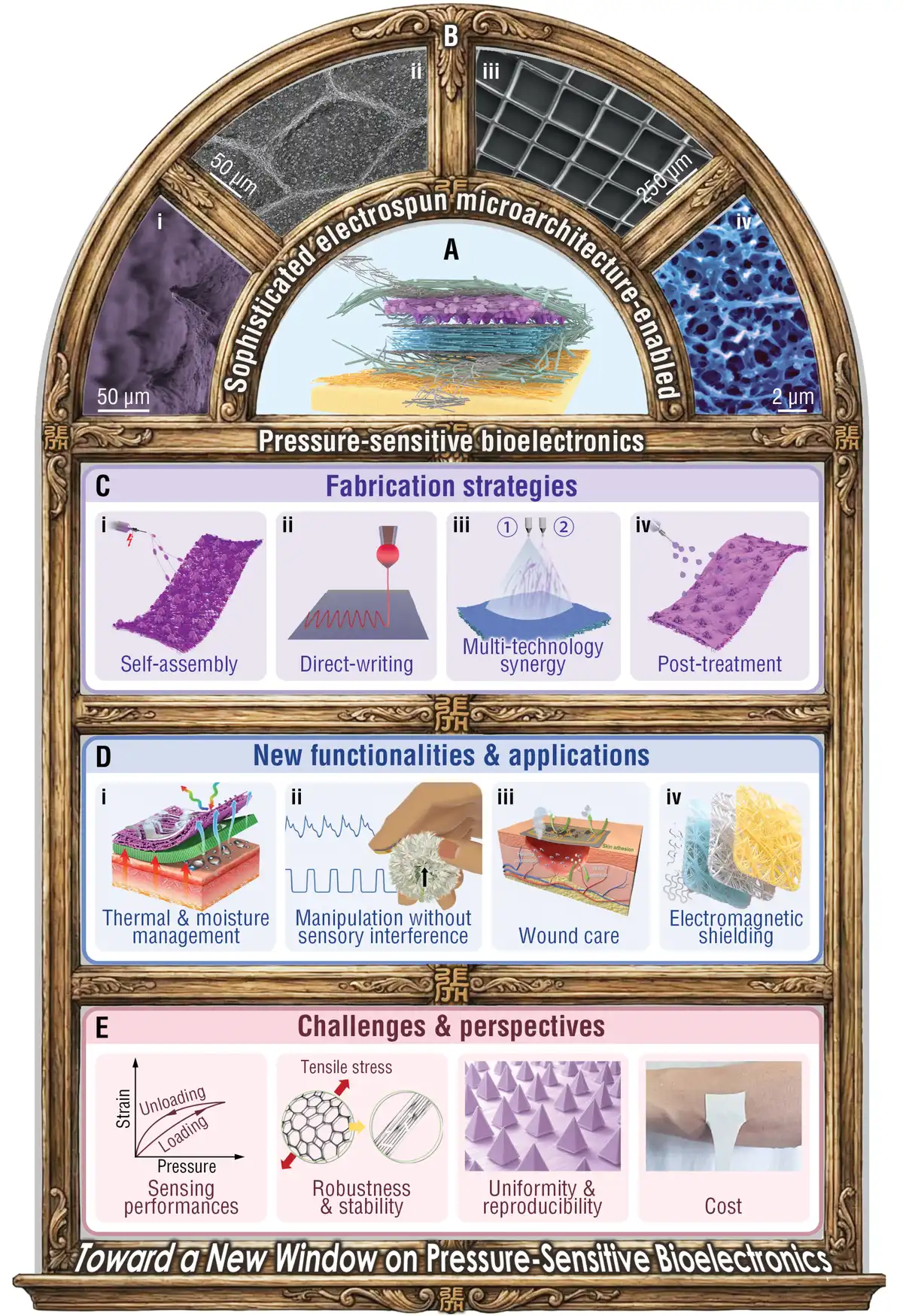
Bioelectronics, which enables the exchange of information, matter, and energy between electronics and biological systems, has emerged as a cornerstone of next-generation healthcare and physiological signal monitoring[1,2]. Among them, pressure-sensitive bioelectronics combine portability and wearability to enable convenient detection of multiple physiological signals, offering new opportunities for personalized healthcare and professional manipulation monitoring[3,4]. For comfortable, continuous, and long-term monitoring, pressure-sensitive bioelectronics demand lightweight breathable structures[5,6]. Electrospinning, a mature and cost-effective technique for producing porous fiber membranes with tunable thickness, has become the predominant strategy for fabricating pressure-sensitive materials[7]. In addition, electrospun fabrics provide broad material selectivity and ultrahigh surface area, maximizing the benefits of the materials to enhance and expand sensor functionalities[8]. Nevertheless, the random fiber stacking in conventional electrospun fabrics implies insufficient microstructural designability, limiting performance tunability across diverse applications[9]. Therefore, three-dimensionally (3D) microarchitected electrospun fabrics with optimized topology and geometric regularity have been developed to meet the stringent performance requirements in complex and extreme applications[10]. For example, electrospun micropyramid arrays (EMPAs) integrate high sensitivity, efficient radiative cooling, and excellent tactile transparency (ie, negligible tactile interference), enabling stable, precise monitoring of eSports players’ fine manipulations and fingertip pulse in hot and humid environments[2]. Moreover, electrospun heterogeneous cancellous structures achieve high charge density while accelerating sweat evaporation and blocking external moisture ingress, endowing bioelectronics with high performance, wearing comfort, and stable operation under humid conditions[11]. This perspective summarizes recent progress in 3D microarchitected electrospun fabric-enabled pressure-sensitive bioelectronics, highlighting structural features, fabrication strategies, application potential, key challenges, and future directions (Figure 1).
Fig. 1.
Summary of 3D microarchitected electrospun fabrics, fabrication strategies, and applications of pressure-sensitive bioelectronics. (A) Schematic diagram of a typical electrospun pressure sensor. (B) SEM images of four 3D microarchitected electrospun fabrics[2,7,10,11]: (i) micropyramid array, (ii) honeycomb-like array, (iii) grid wall, and (iv) cancellous-bone-like structure. (C) Schematic diagrams of 4 typical fabrication strategies[9,12,13]: (i) self-assembly, (ii) direct-writing, (iii) multi-technology synergy, and (iv) post-treatment. (D) Schematic diagrams of new functionalities and applications[7,8,14,15]: (i) moisture and thermal management, (ii) manipulation without sensory interference, (iii) wound care, (iv) electromagnetic shielding. (E) Schematic diagrams of challenges and perspectives[12].
2. Electrospun pressure-sensitive bioelectronics
Pressure-sensitive bioelectronics build a critical bridge between mechanical physiological stimuli and electrical signals, enabling quantitative interpretation of biological mechanical information through diverse sensing mechanisms. According to sensing mechanisms, pressure-sensitive bioelectronics can be classified into 7 types: (i) piezocapacitive, (ii) piezoresistive, (iii) iontronic, (iv) piezoelectric, (v) triboelectric, (vi) flexoelectric, and (vii) electret[1]. Piezocapacitive and piezoresistive sensors transduce external mechanical stimuli into electrical signals, where deformation of the sensitive layer leads to variations in capacitance (C) or resistance (R). They are respectively governed by the following two equations:
where ε0 is the dielectric constant in a vacuum, εr is the relative dielectric constant, A is the electrode area, d is the thickness of the sensitive layer, ρ is the resistivity, L is the length, and A’ is the contact area. Accordingly, to pursue high sensitivity, micro-/nanoarchitectured low-modulus elastomers are typically employed as the sensitive layer[2,10]. Under a given pressure, such layers undergo larger deformations, resulting in more pronounced variations in the physical parameters described in Equations (1) and (2). The iontronic sensor shares a structural similarity with the conventional piezocapacitive device. Compared with the piezocapacitive sensor, its key distinction lies in the nanometer-thick electric double layer at the electrolyte–electrode interface, which can enhance the unit areal capacitance by more than 3 orders of magnitude, thereby markedly improving sensitivity. This unique feature even enables precise detection of subtle force variations under preloaded pressure conditions. The common advantage of piezocapacitive, piezoresistive, and iontronic sensors is their high stability and accuracy in detecting static forces, a feature that has already enabled commercialization. However, their limitation is the relatively slow response time, typically ranging from tens to several hundreds of milliseconds, which makes precise monitoring of dynamic forces challenging.
In contrast to the above 3 types of sensors, piezoelectric, triboelectric, and flexoelectric sensors rely on Maxwell’s displacement current and perform self-powered sensing by converting mechanical signals into electrical signals. Their response times are on the nanosecond scale, making them particularly suitable for monitoring dynamic forces[13]. Moreover, Equations (3)–(5) describe the characteristics and determining factors of their outputs.
where VPE is the open-circuit voltage of the piezoelectric sensor, d33 is the piezoelectric coefficient, T is the applied stress, VTE is the output voltage of the triboelectric sensor, Q is the total free charge on the electrode, subscripts 1 and 2 correspond to different tribolayers, x is the distance between a pair of tribolayers, σ is the surface tribocharge density, PFE is the flexoelectric polarization, μijkl is the flexoelectric coefficient, Tij is the elastic strain, and xk is the position coordinate. Notably, the fundamental origin of the piezoelectric displacement current is the noncentrosymmetric positive and negative charges within unit cell planes. Accordingly, ferroelectric ceramic particles and polymers are usually polarized and then employed to fabricate flexible piezoelectric sensors. The triboelectric displacement current arises from the coupled effects of contact electrification and electrostatic induction. This interfacial effect is primarily determined by the effective contact area and polarity differences of the tribo-materials. Due to the ubiquity of contact electrification, triboelectric sensors offer a broad range of material options. Flexoelectric displacement current is induced by a strain gradient or a nonuniform strain field that locally breaks the inversion symmetry of the material. Consequently, the flexoelectric effect is size-dependent and becomes particularly significant at the nanoscale. Besides, electret sensors operate by local potential changes in the device when pressure is applied to the electret material. Since they often couple piezoelectric and triboelectric effects, their output characteristics are similar to those of piezoelectric and triboelectric sensors.
Electrospinning, as an additive manufacturing technique for microarchitected fabrics, is highly suitable for constructing pressure-sensitive bioelectronics (Figure 1A). For piezocapacitive and piezoresistive sensors, the porous structure of electrospun fabrics significantly reduces the compressive modulus, thereby enhancing device sensitivity[2]. In terms of piezoelectric sensors, the in-situ poling effect during electrospinning aligns dipoles, directly activating the piezoelectricity of the device[1]. For triboelectric sensors, the rough surface of electrospun fabrics increases the effective contact area, thus improving sensing performances (eg, detection limit, sensitivity)[11]. In terms of flexoelectric sensors, the diameter of the electrospun fibers ranges from the micro- to nanometer scale. With appropriate fiber stacking, these micro/nanofibers can effectively activate and enhance the flexoelectric response of the sensor[1]. For electret sensors, the pores formed by the interlaced electrospun electret fibers act as pore dipoles, which can enhance the sensor’s response to external pressure[14]. Beyond traditional microstructures, some 3D microarchitected electrospun structures, featuring unique mechanical and electrical properties, offer greater advantages in optimizing the performance of pressure-sensitive bioelectronics[2]. These will be discussed in the next section.
3. 3D microarchitected electrospun pressure-sensitive fabrics
As the core component of electrospun pressure-sensitive bioelectronics, functional fabrics play a decisive role in enabling multifunctional integration and overall device performance. Conventional electrospun fabrics are thin-film structures that are typically composed of randomly interlaced electrospun fibers. Regardless of whether the fibers are uniform, bead-on-string, porous, hollow, wire-in-tube, or multi-channel-tubes, their surfaces are relatively smooth, with a roughness generally below 1 μm[14]. In contrast, 3D microarchitected electrospun fabrics refer to microstructures with highly ordered arrangements and unit dimensions exceeding 1 μm (eg, EMPAs, [Figure 1B-i][2], electrospun honeycomb-like arrays [Figure 1B-ii][7], and electrospun grid wall arrays[10] [Figure 1B-iii]), or those with topological features that differ significantly from conventional electrospun fabrics (eg, electrospun cancellous structures[11] [Figure 1B-iv]). These 3D microarchitected electrospun fabrics not only retain the inherent advantages of conventional electrospun fabrics but also provide significant enhancements in multiple performances of bioelectronics. For example, EMPAs feature gradient space filling, gradient stress distribution, and gradient refractive index, enabling excellent regulation of force, heat, light, and electricity. As a result, EMPA-based pressure sensors not only exhibit outstanding sensing performance (sensitivity ~19 kPa−1, detection limit ~0.05 Pa, response time ~0.8 ms), but also demonstrate remarkable radiative cooling capability (temperature drop ~4 °C), which helps prevent skin perspiration and thereby enhances sensing stability[2].
3D microarchitected electrospun fabrics can be fabricated by 4 typical strategies: (1) self-assembly, (2) direct-writing, (3) multi-technology synergy, and (4) post-treatment. Self-assembly refers to the technique in which fibers, driven by Coulomb force, surface tension, and other forces during far-field electrospinning, are not randomly stacked but instead organized into ordered microarchitectures (Figure 1C-i)[2]. For example, Zhang’s group develops an electrostatic jet self-assembly technology to fabricate various breathable 3D microarchitected fabrics in a single-step process[2]. This strategy takes advantage of the slow evaporation of low-saturated vapor pressure solvents in precursor solutions, leaving residual solvent in the droplet or jet. The residual solvent tunes the jet’s electrohydrodynamics, thereby controlling its geometric structure, charged state, and aggregation state on the collector, and enabling the precise construction of diverse pressure-sensitive microarchitectures[2,11,13–14–15]. For high-concentration precursor solutions (typically >10 wt%), the residual solvent acts as a sacrificial template, enabling the fabrication of heterogeneous, homogeneous, or gradient porous microarchitectures with interconnected topology, such as the interconnected cancellous structure (Figure 1B-iv). The pores of these microstructures typically range from tens of nanometers to the submicron scale[11,14,15]. In contrast, for low-concentration precursor solutions (typically ≤10 wt%), the charged residual solvent induces heterogeneous charged microdomains that, via electrostatic and related interactions, regulate subsequent jet aggregation state[2,13]. This strategy is used to fabricate microarray structures, such as microprotrusion and micropyramid arrays (Figure 1B-i). The unit structures of these microarrays typically range from a few micrometers to several thousand micrometers[2]. Thanks to its high efficiency and low cost, self-assembly is the most widely used technique for producing 3D microarchitected electrospun fabrics.
Direct writing utilizes medium- or near-field electrospinning to precisely control the trajectory of a single jet, enabling the fabrication of highly ordered microarchitectures (Figure 1C-ii). When a variable deflecting field is applied to the moving jet via aerial electrodes, jet instabilities are suppressed[16]. This enables the fabrication of extremely complex microstructures with submicrometer features, similar to 3D printing. The advantages of direct writing include high design flexibility and fabrication accuracy, while its main limitation is low production efficiency. Multi-technology synergy integrates different types of charged jet processing techniques to simultaneously deposit jets with distinct morphologies onto a single electrospun film, thereby forming 3D microarchitected electrospun structures (Figure 1C-iii). For example, the combination of electrospinning and electrospraying can produce hierarchical micro-nanoprotrusions[9]. Post-treatment refers to subsequent processing of as-prepared electrospun fabrics to optimize their geometric or topological structures (Figure 1C-iv). For instance, nanoimprinting can introduce 3D microarchitecture arrays on the surface, while solvent welding can produce topologically interconnected microarchitectures[13].
4. Emerging functionalities and applications
To meet the increasing demands for sensing precision and functional integration in pressure-sensitive bioelectronics, 3D microarchitected electrospun fabrics have emerged as a powerful structural platform. A key advantage of 3D microarchitected electrospun fabrics lies in their ability to both enhance sensing performance and expand device functionality. On the one hand, their unique physical properties achieve effective optimization of sensitivity, response time, hysteresis, detection limit, and linearity. For instance, gradient 3D electrospun microarchitectures with gradient stress distribution enable larger compressive deformation, thereby improving sensitivity and decreasing the detection limit. Drawbacks of slow response and large hysteresis, arising from friction energy dissipation of electrospun fibers, can be mitigated by tailoring microstructural topology. Specifically, bridging the potential contact interfaces of electrospun fibers into an integrated microarchitecture minimalizes possible friction. Moreover, high linearity can be realized by introducing spherical hierarchical micro-nanostructures, which benefits from the highly linear relationship between the microarchitecture-electrode contact area and the applied load. On the other hand, 3D microarchitected electrospun fabrics provide devices with new functionalities, including (1) moisture and thermal management, (2) manipulation with negligible sensory interference, (3) wound care, and (4) electromagnetic shielding.
The moisture and thermal management capability of 3D microarchitected electrospun fabrics is attributed to their mechanical, thermal, and optical regulation properties. For low-surface-energy electrospun structures, trapped air within the microarchitectural gaps generates elastic repulsion against water droplets, enabling superhydrophobicity and preventing external moisture ingress. Furthermore, Janus or gradient pore-size designs can establish a wettability gradient force and capillary pressure gradient, enabling unidirectional water/moisture transport. During water/sweat transport, heat transfer naturally occurs as well. Introducing high-thermal-conductivity materials into electrospun fibers to form interpenetrated networks further enhances heat dissipation[17]. In addition to heat conduction, heat radiation is also an important mode of heat transfer. Some 3D electrospun microarchitectures function as meta-surface photonic crystals, with tailored fiber diameters and geometries that enhance Mie scattering and mid-infrared emissivity[18], achieving efficient radiative cooling (Figure 1D-i).
Tactile-transparent sensors minimally affect the user’s tactile perception, allowing sensing of their presence without disrupting perception of the object’s critical features, similar to visual transparency. They facilitate understanding and reproducing natural behaviors without sensory interference, playing an important role in fine-manipulation monitoring and limb functional rehabilitation (Figure 1D-ii). 3D microarchitected electrospun fabrics are ideal candidates for such devices. These 3D microarchitected electrospun sensors are breathable, ultrathin, and exhibit extremely low contact stiffness, allowing them to conform seamlessly to skin textures without interfering with the natural deformation of cutaneous mechanoreceptors, thus ensuring tactile transparency. More importantly, the 3D microarchitected electrospun fabrics endow these sensors with sensing performances comparable to lithographically patterned microstructured devices, ensuring practicality while broadening application scenarios. For instance, EMPA-based high-performance tactile-transparent sensors can detect fingertip pulse, fine manipulations, and emotional states of eSports players, enabling skill-level assessment[6].
Wound care and electromagnetic shielding are 2 other crucial applications enabled by 3D microarchitected electrospun fabrics. Through the integration of various functional materials, their highly porous and breathable fibrous networks provide an optimal moist and gas-permeable environment that accelerates tissue regeneration while preventing external bacterial invasion. Moreover, functional components such as antibacterial agents, growth factors, or conductive fillers can be directly incorporated into electrospun fibers, allowing controlled and stimuli-responsive drug release. Such microarchitectured wound dressings not only accelerate recovery but also minimize infection risk, representing a paradigm shift from passive protection to active, intelligent wound management[19]. Additionally, in terms of electromagnetic shielding, electrospun microarchitectures with conductive fillers such as metal nanoparticles, carbon nanomaterials, or MXenes can form continuous and interconnected networks that effectively attenuate electromagnetic radiation through reflection, absorption, and multiple scattering. The electrospun networks not only enhance the shielding effectiveness by extending the propagation pathways of electromagnetic waves but also maintain lightweight, breathable, and mechanically robust properties. This ensures the reliable and stable operation of pressure-sensitive bioelectronics in complex electromagnetic environments[8].
5. Challenges and perspectives
3D microarchitected electrospun fabrics have unlocked diverse functionalities and applications in pressure-sensitive bioelectronics. Nevertheless, challenges in (1) sensing performance, (2) robustness and stability, (3) uniformity and reproducibility, and (4) cost persist (Figure 1E). Overcoming these could pave the way for transformative innovations and impactful applications.
First, the response time and hysteresis performances of electrospun piezocapacitive and piezoresistive bioelectronics still lag behind lithographically patterned microstructured sensors, although 3D microarchitected electrospun fabrics have enabled breakthroughs in sensitivity and detection limits. This limitation arises from energy dissipation caused by inter-fiber contact friction. A promising strategy is to employ advanced electrospinning techniques to optimize the geometry and topology of the microarchitectures, which can reduce interfacial contact and minimize friction. Second, compared with dense film-based devices, fibrous electrospun bioelectronics exhibit lower robustness and stability. A possible solution is to construct more topological interconnections within 3D electrospun microarchitectures to mitigate interlayer delamination and local stress concentrations that may lead to structural failure. Third, the inherent instability of charged jets makes it challenging to achieve high uniformity across different batches of 3D electrospun microarchitectures. Even within the same batch, it is difficult to ensure that each microstructural unit is identical. This variability limits the industrialization of 3D microarchitectured electrospun bioelectronics. Consequently, strict control of processing parameters, such as electric field strength, temperature, and humidity, is required to maximize uniformity and reproducibility. Finally, in practical applications, electrospun bioelectronics often require intimate adhesion to the skin using adhesives, which can damage 3D microarchitected electrospun fabrics upon removal. Their disposable feature increases costs. Therefore, it is necessary to develop more cost-effective materials for producing 3D microarchitectured electrospun pressure-sensitive bioelectronics.
Overall, 3D microarchitected electrospun fabric-enabled pressure-sensitive bioelectronics represent a powerful and versatile platform that bridges advanced structural design with multifunctional bioelectronic performance. By rationally engineering microarchitectural geometry and topology, these systems offer unique advantages in sensing performance enhancement, functional integration, and application adaptability that are difficult to achieve with conventional electrospun fabrics. Although challenges remain in stress-strain mismatch, mechanical robustness, large-area uniformity, and cost-effective manufacturing, continued advances in electrospinning technologies, structural design strategies, and materials innovation are expected to drive this field toward scalable fabrication and real-world deployment.
Acknowledgements
This work was financially supported by the National Natural Science Foundations of China (Grant Nos. 62501320 to Jia-Han Zhang; 62204125 and 62564011 to Zeng Liu), the First-Class Discipline Scientific Research Special Project (Grant No. YLXKZX-NKD-034 to Ningning Sun), the Steed Plan of Inner Mongolia University for High-Level Introduced Talents (Grant Nos. 10000-23112101/277 and 10000-A24106015 to Jia-Han Zhang), the 2024 Research Support Foundation for Introduced Talents of Inner Mongolia Autonomous Region (Grant No. 21700-252905 to Jia-Han Zhang), the Inner Mongolia University Experimental Technology Research Project in 2025 (Grant No. SYJS2025004 to Jia-Han Zhang), the Commercial Research Foundation of Functional Electrospun Textile (Grant No. 21700-5246077 to Jia-Han Zhang), and the Program for Innovative Research Team in Universities of Inner Mongolia Autonomous Region (Grant No. NMGIRT2503 to Jia-Han Zhang and Zeng Liu).
Conflicts of interest
The authors declare that they have no conflict of interest.
Author contributions
Jia-Han Zhang conceived, organized, and wrote the manuscript. Jia-Han Zhang, Ningning Sun, Xidi Sun, Haitao Wang, Zhi Zhang, Jiawei Zhang, Xinrui Wang, and Xin Zhang. contributed to picture plotting. Lijia Pan and Zeng Liu supervised the perspective. All authors discussed and approved the final manuscript.
References
- [1] Zhang J-H, Li Z, Liu Z, et al. Inorganic dielectric materials coupling micro-/nanoarchitectures for state-of-the-art biomechanical-to-electrical energy conversion devices. Adv Mater. 2025;37:e2419081.
- [2] Zhang J-H, Li Z, Xu J, et al. Versatile self-assembled electrospun micropyramid arrays for high-performance on-skin devices with minimal sensory interference. Nat Commun. 2022;13:5839.
- [3] Shin D, Kim S, Park H, et al. Soft Schottky diodes for skin-interfaced electronics enabled by entirely soft components. Soft Sci. 2024;4:22.
- [4] He J, Lyu T, Song D, et al. A universal orientation-engineering strategy for enhancing mechano-electric conversion performance in semi-crystalline biopolymers. Adv Mater. 2025;37:e10157.
- [5] Dong K, Zhang Y, Fan X, et al. Microfiber-based triboelectric acoustic sensors enable self-powered ultrasonic localization and tracking underwater. ACS Sens. 2025;10:1366–1377.
- [6] Zhao J, Fan X, Xie H, et al. Revolutionizing wearable sustainable energy enabled by mechano-electric conversion fibers. Energy Environ Sci. 2025;18:3955–3985.
- [7] Zhang Y, Fu J, Ding Y, et al. Thermal and moisture managing e-textiles enabled by Janus hierarchical gradient honeycombs. Adv Mater. 2024;36:2311633.
- [8] Peng Y, Song J, Zhang Y, et al. Permeable, wet-adhesive, and EMI-resistant liquid metal electronic skin for high-fidelity electrophysiological monitoring in sweaty and electromagnetic environments. Adv Mater. 2025;37:e08041.
- [9] Ge J, Zong D, Jin Q, et al. Biomimetic and superwettable nanofibrous skins for highly efficient separation of oil-in-water emulsions. Adv Funct Mater. 2018;28:1705051.
- [10] Huang Y, You X, Tang Z, et al. Interface engineering of flexible piezoresistive sensors via near-field electrospinning processed spacer layers. Small Methods. 2021;5:2000842.
- [11] Zhang J-H, Li Y, Du J, et al. Bio-inspired hydrophobic/cancellous/hydrophilic trimurti PVDF mat-based wearable triboelectric nanogenerator designed by self-assembly of electro-pore-creating. Nano Energy. 2019;61:486–495.
- [12] Zhang S, Liu H, Yu J, et al. Multi-functional flexible 2D carbon nanostructured networks. Nat Commun. 2020;11:5134.
- [13] Zhang J-H, Li Z, Shen B, et al. Electric displacement modulation under internal field for high-performance mechanical-to-electrical energy generator. Cell Rep Phys Sci. 2024;5:102025.
- [14] Zhang J-H, Zhou Z, Li J, et al. Coupling enhanced performance of triboelectric–piezoelectric hybrid nanogenerator based on nanoporous film of poly(vinylidene fluoride)/batio3 composite electrospun fibers. ACS Materials Lett. 2022;4:847–852.
- [15] Zhang J-H, Li Y, Hao X. A high-performance triboelectric nanogenerator with improved output stability by construction of biomimetic superhydrophobic nanoporous fibers. Nanotechnology. 2020;31:215401.
- [16] Liashenko I, Rosell-Llompart J, Cabot A. Ultrafast 3D printing with submicrometer features using electrostatic jet deflection. Nat Commun. 2020;11:753.
- [17] Miao D, Wang X, Yu J, et al. A biomimetic transpiration textile for highly efficient personal drying and cooling. Adv Funct Mater. 2021;31:2008705.
- [18] Liu J, Zhai H, Li J, et al. Enhancing wearable electronics through thermal management innovations. Wearable Electr. 2024;1:160–179.
- [19] Huang X, Zhang Q, Yang Y, et al. A skin-interfaced three-dimensional closed-loop sensing and therapeutic electronic wound bandage. Nat Commun. 2025;16:5782.
This article is available under Open Access.
© 2026 The Authors